
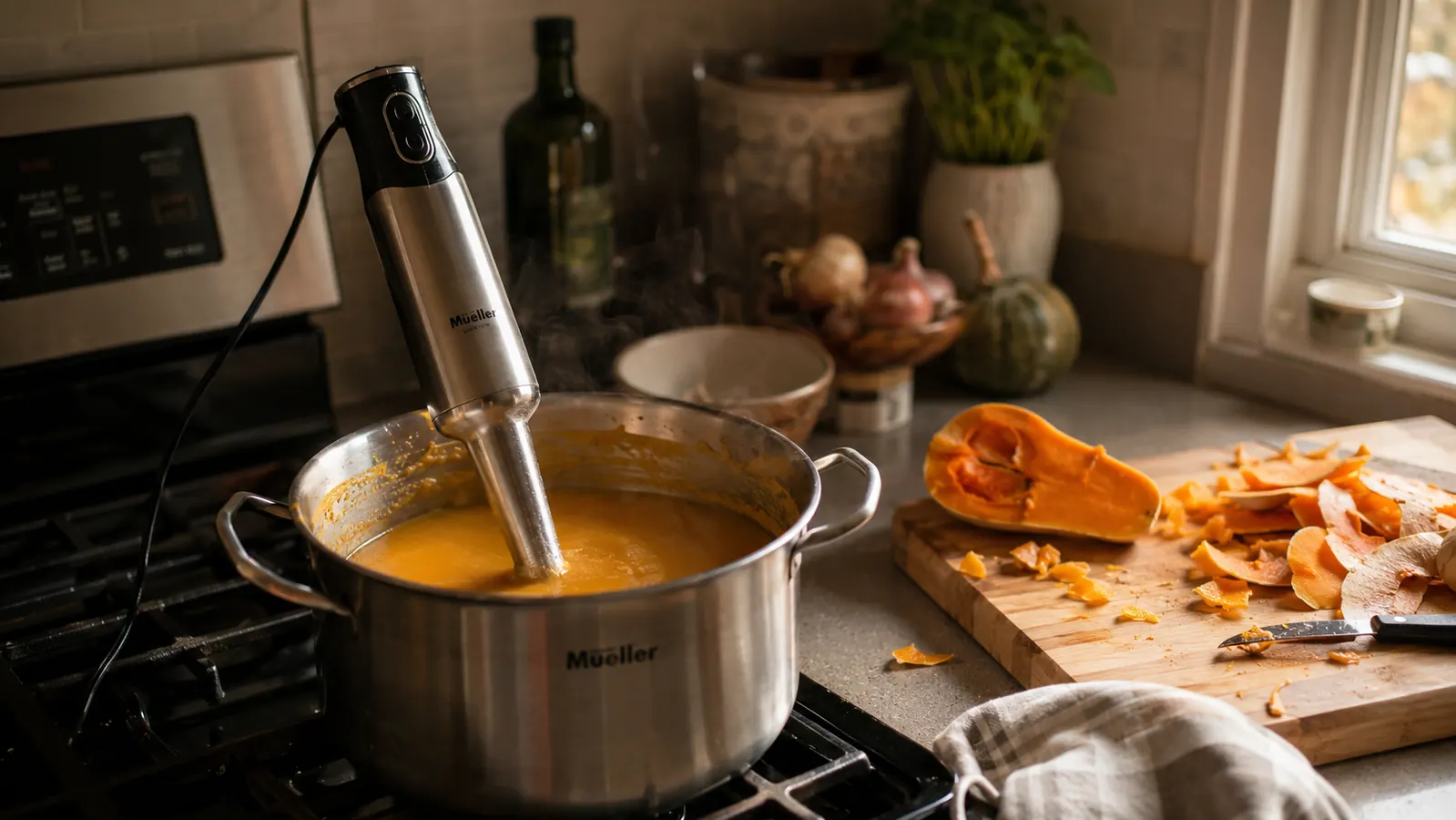
I bought the Mueller Immersion Blender in February because I was tired of hauling my countertop blender out for a single pot of soup. I live in a one-bedroom apartment in Providence with a kitchen that fits exactly one person comfortably, and every appliance I own has to earn its cabinet space. Five months later, this thing has pureed its way through more soups, sauces, and the occasional smoothie than I can count, and it's become the gadget I grab without thinking twice.
This isn't a review written after one weekend with the box. I've used the Mueller Immersion Blender close to once a week since February, mostly for weeknight soup and a running project to get my tomato sauce smoother without dirtying a second appliance. Short version: it's earned its spot in my one drawer of tools I'd actually replace if they broke, but it has real limits I ran into more than once.
I almost returned my first stick blender, a different brand, after it struggled with a simple carrot soup and left stringy bits behind no matter how long I ran it. That experience is why I went in skeptical here, and part of why I kept using this one long enough to write an actual long-term review instead of a first-week impression.
The Quick Verdict
A genuinely capable stick blender for soups, sauces, and small-batch smoothies, with an ergonomic grip that holds up over long sessions and a motor that hasn't slowed down once in five months, though the included chopper beaker is smaller than I'd like.
Amazon Check Today's Price →Tired of dragging out the countertop blender for one pot of soup?
See today's price and current availability for the Mueller Immersion Blender on Amazon before your next soup night.
Amazon Check Today's Price on Amazon →How I've Used It
My testing has been ordinary weeknight cooking, not a lab setup. I use the blender directly in the stockpot for butternut squash soup, potato leek soup, and a roasted red pepper soup I make on a loop from October through March. I've used it for pan sauces after searing chicken thighs, for homemade mayonnaise twice, and for blending soaked cashews into a cream sauce for pasta. I also ran it through smoothies on maybe a dozen mornings when I didn't feel like dragging out the full-size blender for one serving.
I did not use it for anything with ice cubes straight out of the freezer, because the manual is clear that it's built for softer ingredients and I didn't want to test that boundary on a blender I actually wanted to keep working. I also avoided any batch bigger than what fits in my largest stockpot, since the shaft length caps out around eight inches submerged.
One thing I changed early on: I stopped trying to blend directly in a wide, shallow pan. The blender works best in something with enough depth that the blades stay fully submerged, so I moved my pan sauces into a deeper saucepan before finishing them, and splatter dropped noticeably.
I also started keeping a small notebook of which speed setting worked for which recipe, mostly so I'd stop guessing. That habit alone cut my average blending time down because I wasn't stopping partway through to bump the dial up or down.
Power and Speed, Five Months In
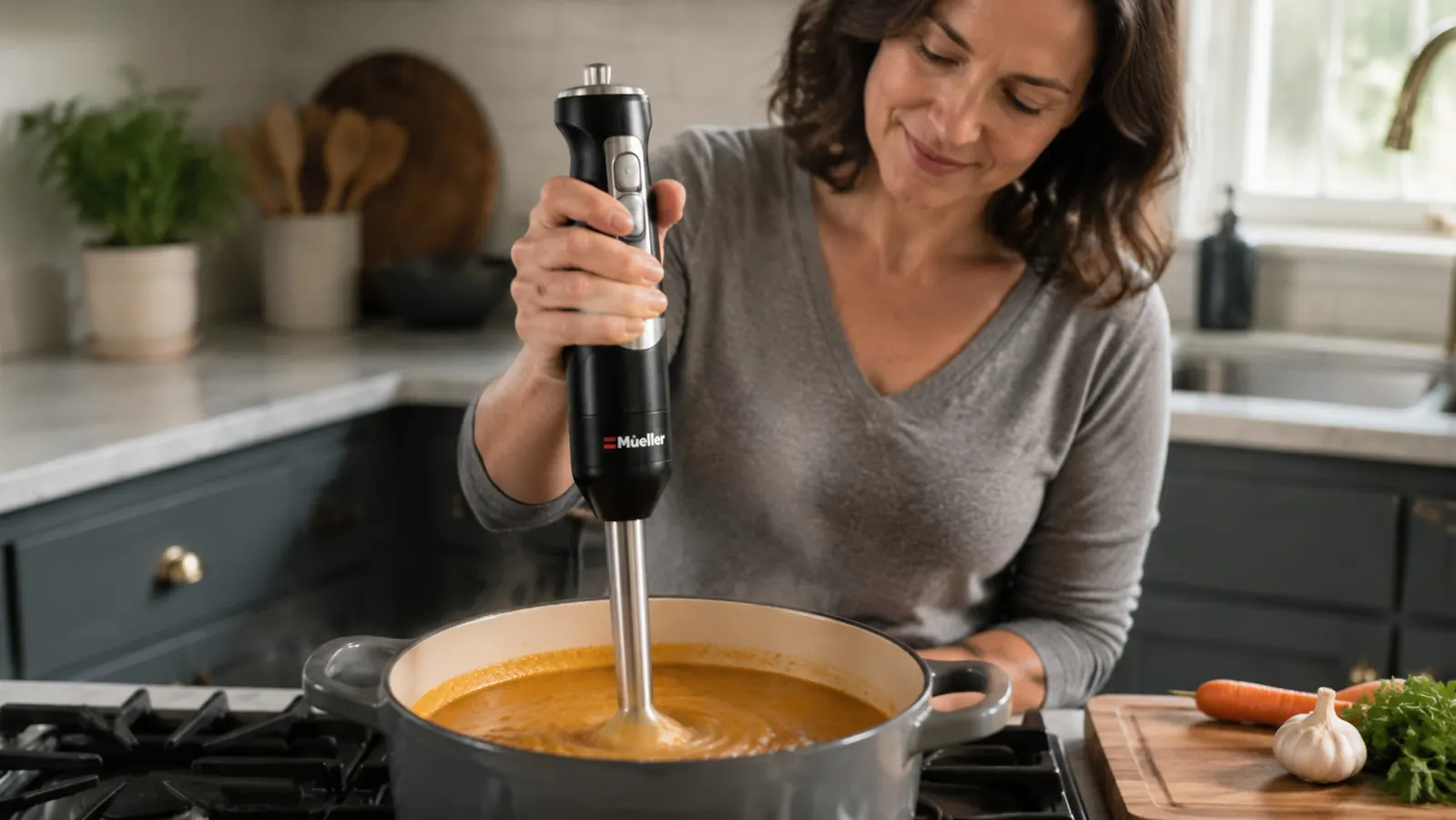
The Mueller has eight speed settings plus a turbo button, and in practice I use maybe three of those settings regularly. Speed two or three handles most soup blending without launching hot liquid up the sides of the pot, and I only reach for turbo when I'm trying to break down something stubborn, like the last chunks of roasted squash that didn't fully soften in the oven.
The motor hasn't shown any sign of slowing down, which genuinely surprised me given how often I've used it. I timed a full pot of potato leek soup from chunky to silky smooth back in February: just under ninety seconds. I did the same test again last month with the same recipe and got the same result within a few seconds, so whatever power it started with, it's holding onto.
The one adjustment I made after the first few uses was holding the blender at a slight angle rather than straight down, which cuts down on air pockets that otherwise slow the blending and cause more splashing near the top of the pot.
I've also noticed the low speeds are genuinely useful, not just filler settings between off and turbo. Speed one is soft enough that I use it to gently loosen a thick sauce that's just come off the stove without it seizing up and spitting hot liquid back at me.
The Attachments I Actually Use
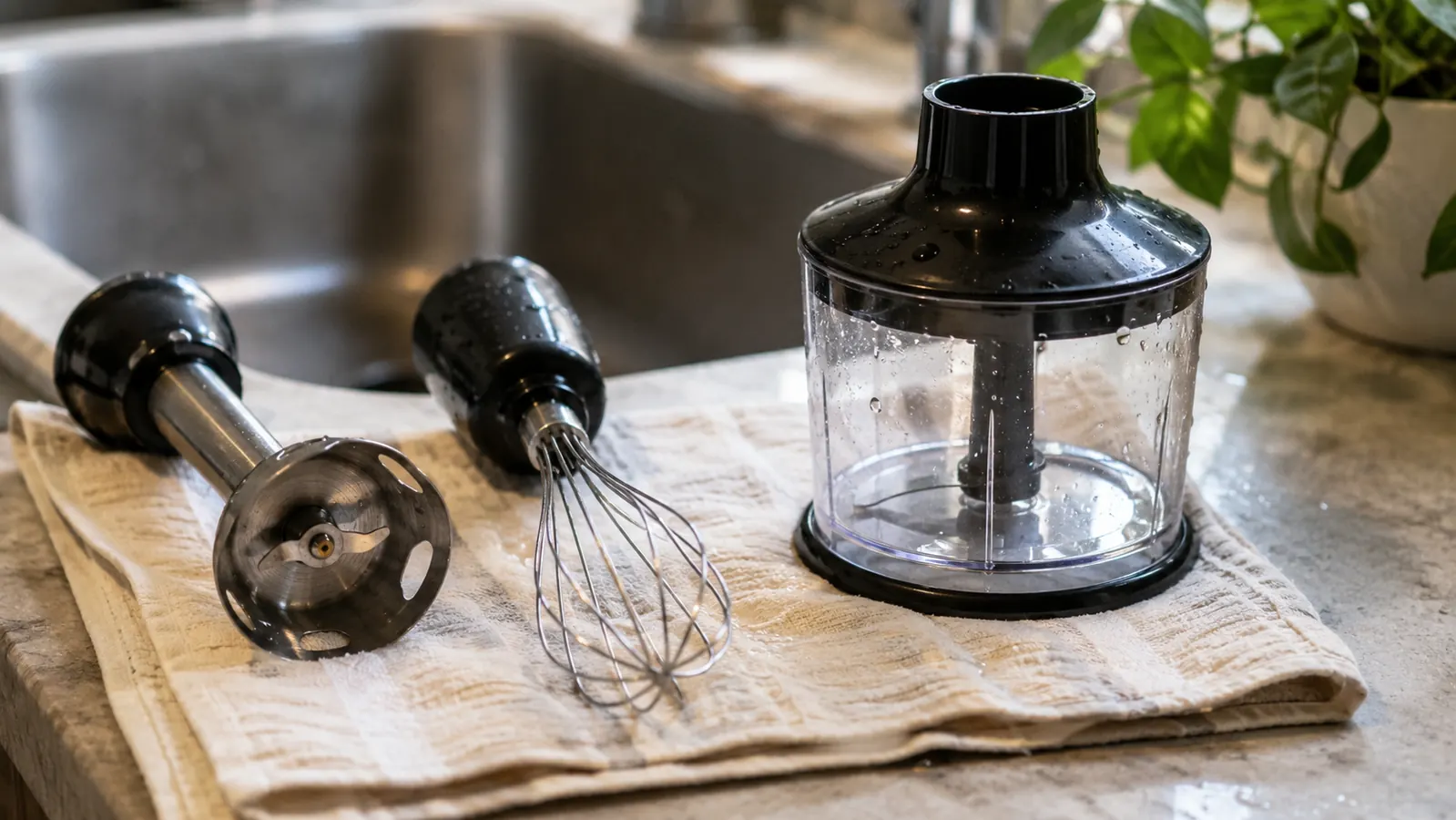
The kit comes with a blending shaft, a whisk attachment, and a small chopper beaker. In five months, the blending shaft has done about 80 percent of the work. It's the piece I reach for on autopilot for soups and sauces, and it's the reason I bought the thing in the first place.
The whisk attachment gets used maybe once every couple of weeks, mostly for whipping cream for a dessert or beating eggs for an omelet when I don't want to dirty a mixing bowl and a separate whisk. It works well for small quantities, though it takes noticeably longer than a stand mixer would, which I expected going in.
The chopper beaker is the piece I use least, and it's also the one I'd change if I could. It's fine for mincing a small handful of garlic or a few tablespoons of herbs, but the bowl is smaller than I expected from the product photos, so anything beyond a quarter cup of ingredients means running it in batches. I still use it for garlic and shallots a few times a month, but it hasn't replaced my knife the way the blending shaft replaced my countertop blender.
Comparing It to My Old Countertop Blender
I still own my countertop blender, a decade-old pitcher model that lives on the top shelf now instead of the counter. Before February, I'd use it for soup by ladling hot liquid into the pitcher in two or three batches, which meant more dishes and a genuine risk of a hot splash if the lid wasn't seated right.
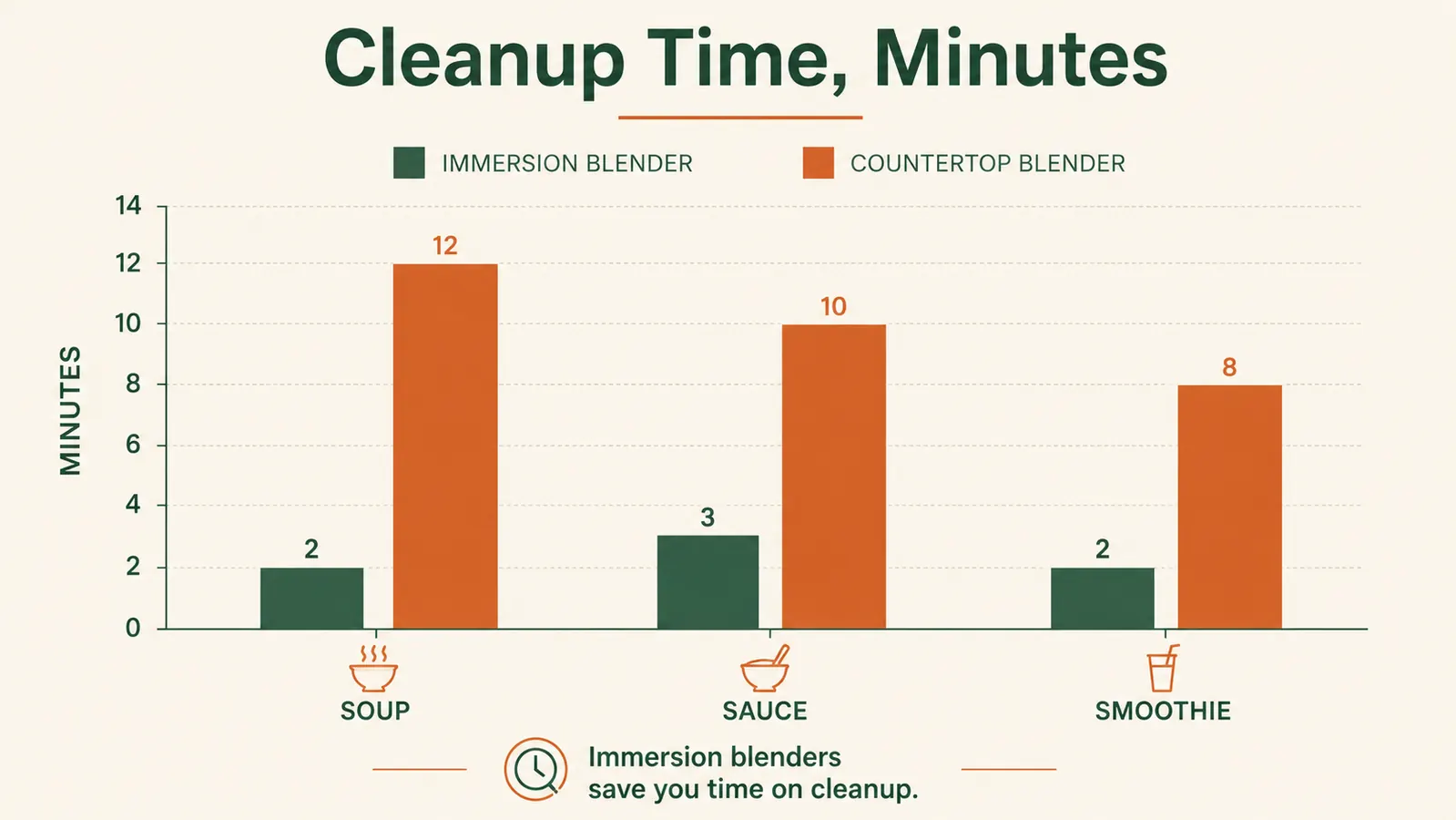
The immersion blender skips that whole step. I blend directly in the pot I already cooked in, which means one fewer container to wash and no transferring hot liquid between vessels. For smoothies, though, the countertop blender still wins because it crushes ice and frozen fruit in a way the stick blender simply isn't designed to handle.
So the two tools ended up dividing the work rather than one replacing the other. Anything hot and already in a pot goes to the Mueller. Anything cold with ice or frozen fruit still goes to the pitcher blender on the top shelf.
Splatter, Noise, and Cleanup Over Time
This is the part I expected to be a bigger hassle than it turned out to be. Stick blenders have a reputation for splattering hot soup everywhere, and mine did exactly that the first two or three times I used it, mostly because I was pulling it in and out of the pot instead of keeping it fully submerged while running.
Once I got in the habit of starting the blender only after the shaft is under the surface, and tilting the pot slightly rather than tilting the blender, splatter dropped to almost nothing. Noise is about what you'd expect from a motor this size, loud enough that I don't run it after my downstairs neighbor's bedtime, but not so loud it's unpleasant for a few minutes of soup blending.
Cleanup is where this thing genuinely beats a countertop blender. The detachable shaft rinses clean under the tap in about ten seconds since there's no wide base or gasket to fuss with, and the shaft itself is dishwasher safe on the top rack, which I've done more than twenty times with no clouding or looseness in the fit.
Durability Check at Five Months
The stainless steel blending shaft still looks and performs the way it did on day one. No pitting, no dulling that I can detect, and the fit between the shaft and the motor housing is still snug with no wobble. The plastic body of the motor housing has picked up a few small marks from resting against my countertop edge, purely cosmetic and nothing that's affected how it runs.
The one part I keep half an eye on is the button that locks the speed dial in place during turbo mode. It's still responsive, but I've noticed it takes a touch more pressure to engage than it did in February, which makes me think it's a part I'd want to watch if I keep using this at the same pace for another year.
What I Liked
- Motor power hasn't noticeably dropped after roughly five months of weekly use
- Detachable stainless shaft rinses clean in seconds, dishwasher safe on top rack
- Ergonomic grip stays comfortable through a full pot of soup without hand fatigue
- Whisk attachment is a genuine bonus for small whipping and beating jobs
Where It Falls Short
- Chopper beaker is smaller than expected, needs batching for anything past a quarter cup
- Splatters noticeably if you pull the shaft above the liquid surface while running
- Not built for crushing ice straight from the freezer
- Turbo lock button needs slightly more pressure than it did when new
It's not replacing my countertop blender for smoothies every morning. It's replacing the two extra dishes I used to wash every time I made soup.
Who This Is For
If you make soup, sauces, or purees more than once a month and you're tired of transferring hot liquid into a countertop blender in batches, this is a real upgrade in convenience. It's also a good fit for a small kitchen where every appliance needs to justify its storage space, since the whole kit stores in a single drawer.
It's also worth it if you cook for one or two people and hate the idea of dragging out a full-size blender, cleaning the pitcher, and drying it, just to puree a single pot of soup. The scale of the tool matches the scale of a lot of weeknight cooking better than a countertop appliance does.
Who Should Skip It
If your main use case is daily smoothies with frozen fruit and ice, a proper countertop blender is still going to serve you better since this isn't built for that kind of grinding. And if you regularly need to chop larger batches of vegetables or herbs, the included chopper beaker will feel undersized fast, and you're better off pairing this with a separate food processor rather than expecting the small beaker to cover that job too.
If you're cooking for a large family and regularly blending soup by the double batch, you may also find yourself wishing for a longer shaft or a second unit, since I've noticed the eight-inch reach starts to feel short once a pot gets close to full.
Ready to cut soup night down to one pot and one tool?
See current pricing and availability for the Mueller Immersion Blender on Amazon.
Amazon Check Today's Price on Amazon →