
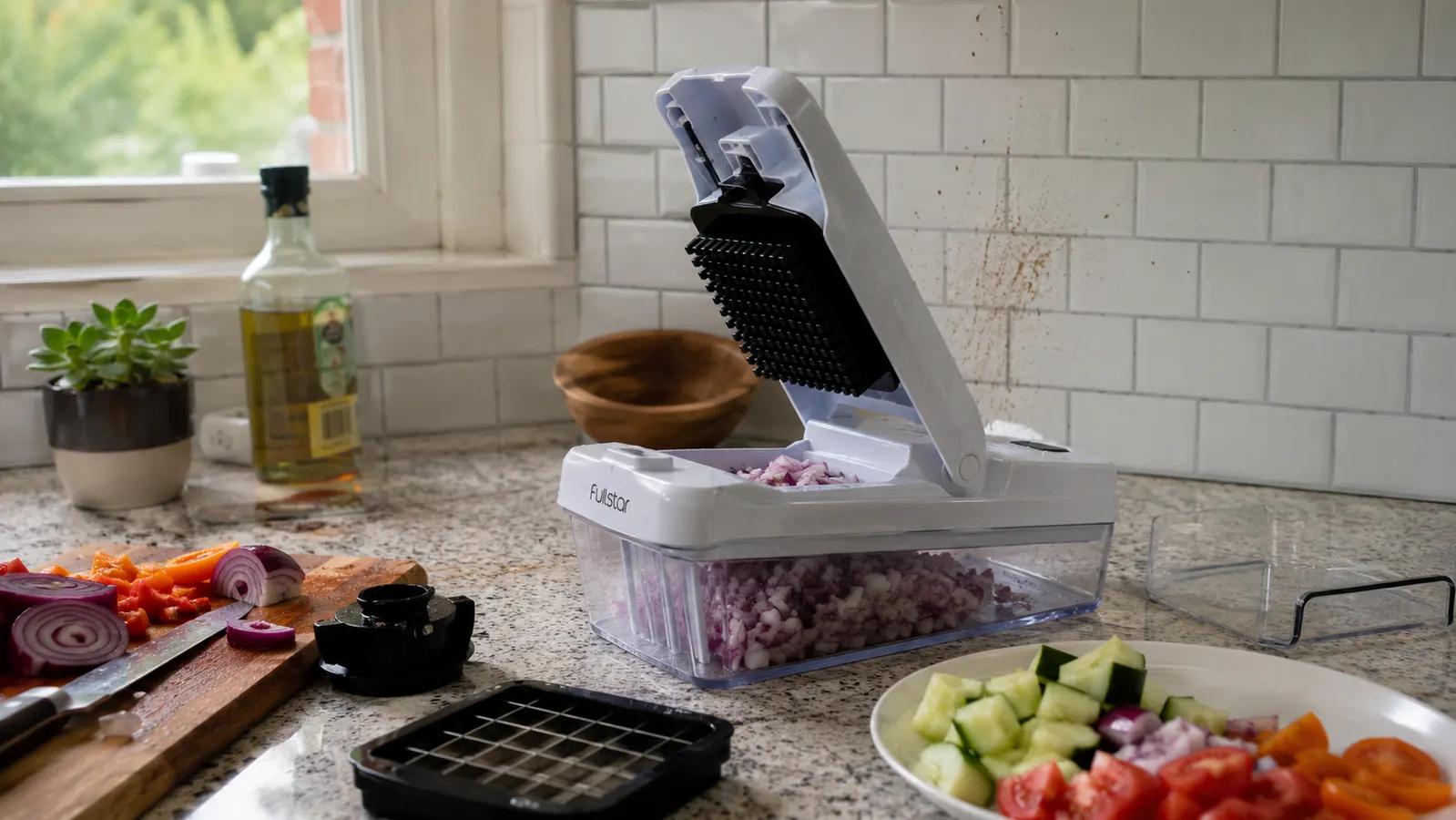
The reviews on Amazon make the Fullstar sound like it reinvented vegetable prep. A hundred and twenty-eight thousand of them, most of them glowing, most of them written in the first week of ownership when everything still feels like magic. What none of those five-star blurbs mention is the afternoon I sprayed onion juice across my kitchen cabinets because I pressed down on a blade that wasn't fully seated, or the two weeks I spent hunting for a blade insert that had slid behind the silverware drawer and gone quietly missing.
I've owned this chopper long enough now that the honeymoon period is over, and I think the honest version of this review looks pretty different from the one that gets written a week after unboxing. This isn't a takedown. I still reach for it most weeks. But if you're deciding whether it deserves a spot in your kitchen, you deserve the version that includes the annoying parts, not just the highlight reel.
The Quick Verdict
Still earns its spot in my drawer, but it comes with a learning curve, a real mess factor, and a few quirks most glowing reviews never mention.
Amazon Check Today's Price →Before you add another gadget to your drawer, here's what to actually expect
See today's price and current availability for the Fullstar chopper on Amazon before you decide.
Amazon Check Today's Price on Amazon →How I Actually Tested It
Most reviews of this chopper get written after a handful of uses, when everything is still novel and every gripe feels forgivable. I went a different way. For a little over two months I used it the way I actually cook, which means some nights I rinsed it immediately and some nights I left diced onion sitting in the container until the next morning because I was tired and the dishes could wait. I wanted to see what happens when you treat it like a real kitchen tool instead of a product you're on your best behavior around.
I also kept a running note on my phone titled, unglamorously, "chopper gripes," and added to it every time something annoyed me, even small things. That list ended up longer than I expected, which is part of why this piece exists. Most of what's below came straight from that note, not from sitting down and trying to remember the good and bad after the fact.
I tried to break my own good habits on purpose a few times too. I pressed down without checking the blade was fully seated. I let a friend's ten-year-old try it under supervision to see how intuitive the lid latch really was for someone who'd never used one. I ran the spiralizer attachment on vegetables that were slightly past their prime instead of always using perfectly fresh produce. None of that is how the five-star reviews describe their testing, but it's closer to how this thing actually lives in a kitchen.
The "No More Tears" Claim, Tested Honestly
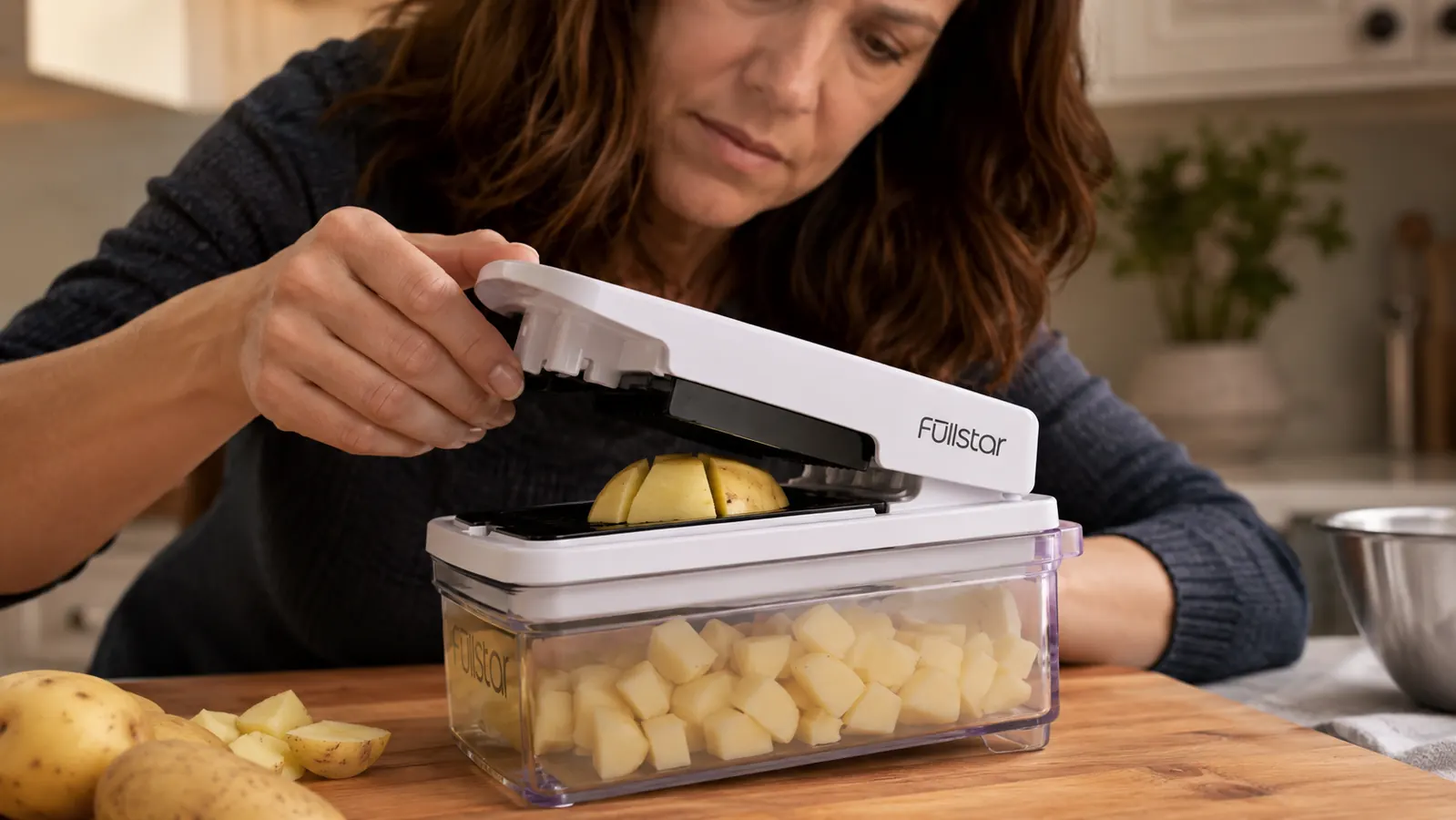
A chunk of the marketing language around this style of chopper leans on the idea that dicing onions inside a sealed container keeps the fumes contained and spares you the crying. My eyes still watered dicing a large yellow onion, maybe a little less than with a knife and cutting board, but not the dramatic difference the copy implies. The container catches the juice and pieces, not the vapor, and vapor is what actually gets your eyes.
I don't think this is dishonest marketing so much as an oversold detail that gets repeated review after review because nobody bothers to fact-check it against their own actual eyes. If tear-free onion dicing is your main reason for buying this, temper your expectations. You'll still want to crack a window or run the exhaust fan for a big batch.
The Splash Radius Nobody Warns You About
Here's the thing that would've genuinely changed my buying decision if I'd known it going in. When a blade isn't seated all the way, or when you're dicing something with a lot of liquid, like a very ripe tomato or a juicy bell pepper, pressing down hard can force a fine spray out through the edges of the lid instead of everything staying neatly contained in the cup below. I learned this the hard way on a Tuesday, mid-week, dicing a tomato I should have known better than to run through the grid at all, and ended up wiping down my cabinets and the front of my shirt.
It's not a constant problem. It happened maybe four or five times total over two months, almost always with softer or juicier produce, or when I was rushing and didn't double check the blade seating before pressing. But it's real, it's messier than a knife ever is, and it's the exact kind of detail that gets left out of a review written after a single tidy demo run in good lighting.
My workaround now is boring but effective. I check that the blade insert clicks fully into place before I press, I never run anything with high liquid content like tomatoes or citrus through it, and I keep a kitchen towel draped over the counter edge on the side facing my cabinets just in case. None of that was in the instruction booklet. All of it came from cleaning onion juice off tile.
The Blade Insert That Almost Got Lost For Good
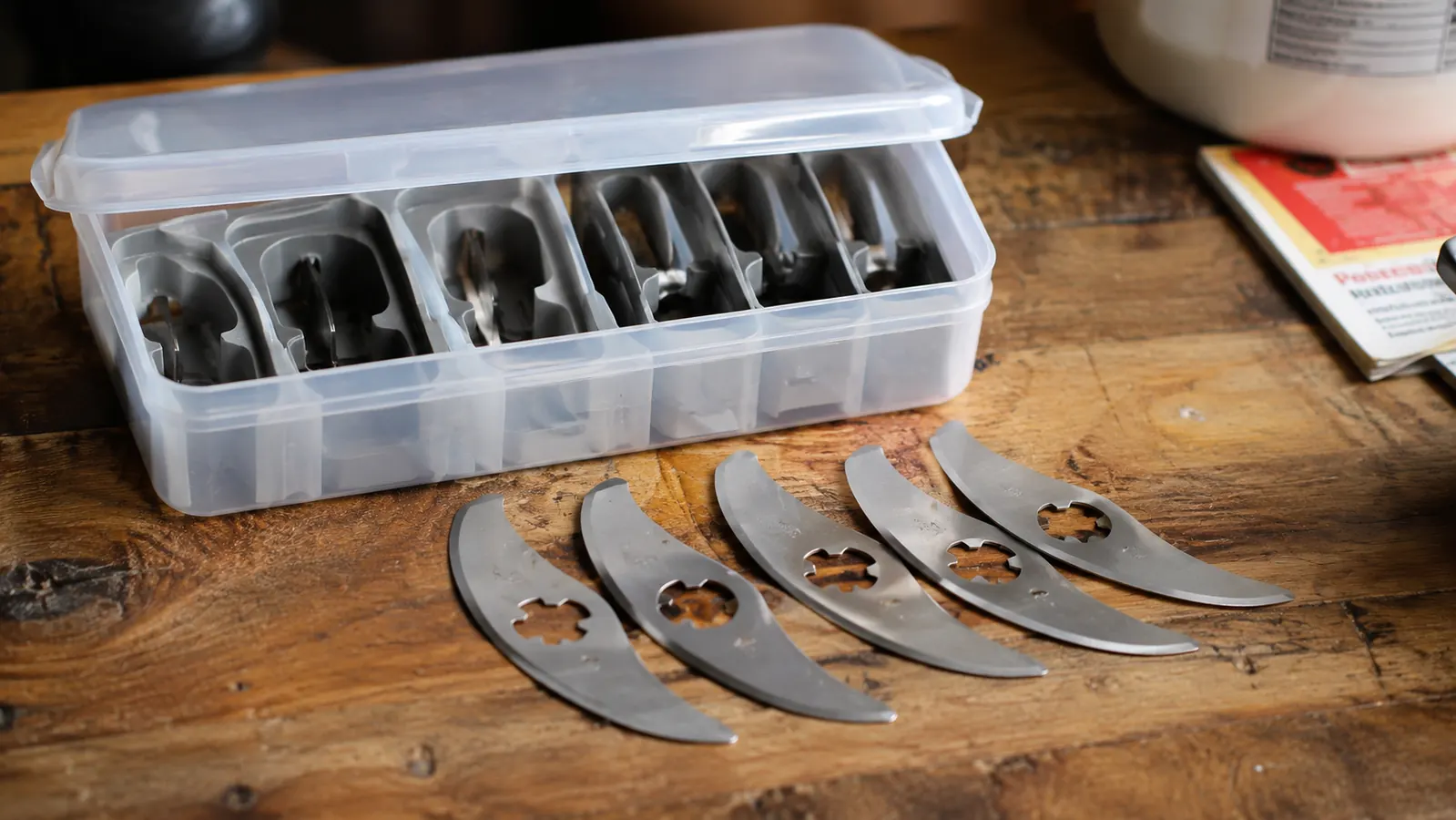
The set ships with a plastic storage case meant to keep every blade insert organized in its own slot. In theory this solves the classic multi-piece-gadget problem where parts scatter across your kitchen and you can never find the one you need. In practice, the case lid doesn't snap shut with much conviction, and after a few weeks of opening and closing it while my hands were still a little wet, it popped open in a drawer and one of the finer blade inserts slid out and wedged itself behind a utensil tray.
I spent almost two weeks defaulting back to a knife for fine dice work because I genuinely thought the insert was gone. It turned up when I pulled the whole drawer out to clean underneath it, which is not a maintenance task most people do regularly. If you buy this, I'd suggest labeling the storage case or adding a rubber band around it, because the case alone isn't quite trustworthy enough to prevent this exact scenario from happening to you too.
The lid latch has its own small learning curve that nobody mentioned to me before I bought it. It only presses down cleanly if you line up the hinge just right, and for the first week I kept getting a half-press where the lid would catch at an angle and nothing would cut evenly. Once you get the muscle memory, it becomes automatic, but that first week involved more fiddling than any of the glowing reviews prepared me for.
What Happens If a Blade Actually Breaks
One detail I never see mentioned before purchase: the blade inserts aren't sold individually in any straightforward way. I went looking after a friend mentioned her julienne blade had cracked at a corner after about four months of regular use, thinking it would be a quick five-dollar add-on purchase to replace just that one piece. It isn't. What's available is mostly the full replacement set or a different bundle entirely, which means a single cracked blade can turn into buying most of the product again rather than a small fix.
That's a meaningful thing to know going in, because the marketing frames this as a buy-it-once kitchen tool, and for the plastic housing and container, that's mostly true. The blade inserts are the wear item, and if one fails outside whatever warranty window applies, you're not looking at a cheap swap the way you would be with, say, a replacement blade for a standalone mandoline.
My own blades haven't cracked in two-plus months, so I can't speak to how common this actually is. But it's worth budgeting for mentally rather than assuming, the way the product photos imply, that this is a lifetime purchase with zero ongoing cost. Treat it as a tool with a wear item baked in, the same way you'd think about a mandoline blade or a peeler edge, and you won't be caught off guard later.
Keeping It Away From Curious Hands
This isn't a knife, but the blade grid inside each insert is genuinely sharp, sharp enough that I nicked a knuckle rinsing one under running water when I wasn't paying attention to where my fingers were relative to the grid pattern. That's a normal kitchen risk, the same as any blade, but it's less obvious than a chef's knife because the grid looks almost decorative until your skin meets it.
The bigger issue is when the pieces are disassembled and drying in a rack. A friend's toddler reached toward the dish rack one afternoon while the blade inserts were sitting out, drawn to the bright plastic color, and it was only a quick redirect that kept it from becoming an actual scare. Nothing in the packaging warns you clearly enough about this, and if you've got small kids or curious pets in the house, I'd treat the disassembled blade inserts the same way you'd treat a chef's knife left on a drying rack, which is to say, not left within easy reach.
Where the Marketing Photos Oversell It
The product photos show clean, uniform julienne strips and perfect small dice with almost no effort implied. In real use, the julienne blade struggles noticeably with anything less than firm, and I've had entire attempts on slightly soft zucchini turn into mangled shreds instead of clean strips. Carrots work fine because they're dense and consistent, but the marketing photos don't tell you that ingredient choice matters this much to your results.
The spiralizer attachment is the other spot where the photos oversell the experience. It works, technically, but it clogs on anything with seeds or a soft core more often than the smooth demo videos suggest, and clearing a clog mid-prep means disassembling a piece you just assembled, which erases most of the time savings you were counting on for that dish.
None of this makes the chopper bad. It makes the marketing a little rosier than the day-to-day reality, which is true of most kitchen gadgets if I'm being fair. I just wish more reviews said so plainly instead of repeating the same three flattering use cases every product page leads with.
What I'd Buy Instead If I Were Starting Over
If I were shopping with the knowledge I have now instead of the marketing copy I had then, I'd think harder about how much of my prep is actually onions, peppers, and firm root vegetables versus soft produce and delicate cuts. For the firm stuff, this chopper genuinely earns its keep and I'd buy it again without hesitation. For anything that needs thin, precise slicing, like potatoes for a gratin or cucumbers for a salad, a dedicated mandoline slicer handles it more predictably and with less risk of the mush or splash issues I ran into here.
I also seriously considered just sticking with a sharp chef's knife and a good cutting board before buying this, and there are nights now where I still reach for the knife specifically because it's less setup for a small job. If you're on the fence, it's worth reading a straight knife-versus-chopper comparison before you decide, since the honest answer is that this tool wins on volume and loses on small single-ingredient jobs, not that it wins across the board.
What tipped me toward keeping it, in the end, wasn't any single feature. It was doing the math on how many nights a week I'm dicing more than one vegetable at real volume, versus how many nights I'm doing a single small job a knife handles faster. For my actual cooking habits, the volume nights won out, but it was closer than the marketing copy would have you believe, and it's worth running that same honest math on your own week before you order one.
The gadget doesn't fail quietly. When it fails, it fails in your face, literally, and nobody puts that in the five-star review.
What I Liked
- Genuinely fast for onions, peppers, and firm vegetables in volume
- Container catches most diced pieces, cutting down on extra dishes
- Blade edges have stayed sharp through two-plus months of regular use
- Handles repetitive dicing without the hand fatigue a knife causes
Where It Falls Short
- Can spray juice through the lid edges if a blade isn't fully seated or produce is too soft
- Blade storage case doesn't latch securely, small inserts can go missing
- Lid latch has a real learning curve the first week
- Julienne blade and spiralizer attachment underperform on anything less than firm produce
- No easy way to buy a single replacement blade if one cracks
- "No tears" onion marketing oversells the actual difference
Who This Is For
If you're willing to learn its quirks, the way you learn any tool's quirks, and most of your prep is onions, peppers, potatoes, and other firm vegetables in real volume, this is worth the drawer space. It's also a solid pick if you're comfortable troubleshooting a small mechanical annoyance now and then in exchange for real time saved on the vegetables it handles well.
Who Should Skip It
If a splash on your cabinets or countertop would genuinely bother you, or if most of your cooking involves soft produce like tomatoes, ripe fruit, or delicate greens, this isn't the tool that's going to make your life easier. And if losing a small plastic part for two weeks would drive you up a wall, or you've got small kids and nowhere secure to keep a disassembled blade insert away from a drying rack, the storage and safety quirks here are reason enough to think twice before buying.
Know the quirks going in, and it's still a solid buy
Check today's price and current availability for the Fullstar Vegetable Chopper on Amazon.
Amazon Check Today's Price on Amazon →