

I put off buying the Benriner Mandoline Slicer for almost two years because of exactly what you're probably worried about right now. The internet is full of stories about mandoline injuries, and I didn't want to become the next cautionary tale in someone's forum post. My cousin Elena cut herself badly enough on a cheap plastic mandoline back in 2019 that she still refuses to touch one, and that story sat in the back of my mind every time I almost added this one to my cart. What finally changed my mind was watching my neighbor Yusuf, a former line cook, slice a whole daikon radish into paper-thin rounds in under a minute without a single wasted motion.
I bought mine in April, and I want this review to be the honest version, not the polished one. Plenty of sites will tell you a mandoline is either a miracle tool or a horror story, and neither extreme is useful if you're actually trying to decide whether to buy one. So here's what surprised me: the parts that were harder than I expected, the small design choices that annoyed me more than they should have, and the specific habit that finally made me trust the blade instead of just fearing it. If you want the long-term, day-to-day usage story, I've written that separately. This one is for whoever is still hovering over the buy button.
The Quick Verdict
Sharper and more capable than most home cooks expect, but it demands real habits nobody mentions in the marketing copy, and the learning curve is longer than the reviews suggest.
Amazon Check Today's Price →Curious if it's really as sharp as everyone says?
See today's price and current availability on Amazon before you decide.
Amazon Check Today's Price on Amazon →How We Tested
My testing wasn't scientific, just honest. Over six weeks I used the Benriner on daikon radish, sweet potatoes, zucchini, red onions, and a batch of Yukon golds for a scalloped potato dish I make maybe once a month. I didn't cherry-pick easy vegetables. I specifically went looking for produce that would expose weaknesses, things with uneven shapes, tough skins, or a tendency to slip, because that's where a lot of online reviews go quiet.
All of this happened in my actual kitchen, not a test lab, on the same laminate countertop I use for everything else, which meant working around normal interruptions, a ringing phone, a kettle going off, the kind of real-world distractions that don't show up in a controlled review setup. I think that matters, because most kitchen accidents with any sharp tool happen exactly when attention slips for a second, not during focused, careful demonstration slicing.
I also asked two people to use it who'd never touched a mandoline before, my roommate Priyanka and my father, mostly because I wanted to know how it behaved in hands that hadn't already adjusted to its quirks. Watching someone unfamiliar struggle with the thickness dial or hesitate over the guard told me more about the honest learning curve than another month of my own practiced use would have.
What follows isn't a defense of the product or an attack on it. It's what actually happened across those six weeks, including the moments I'd have quietly edited out if this were a sponsored post instead of my own honest account.
What Nobody Tells You About the Learning Curve
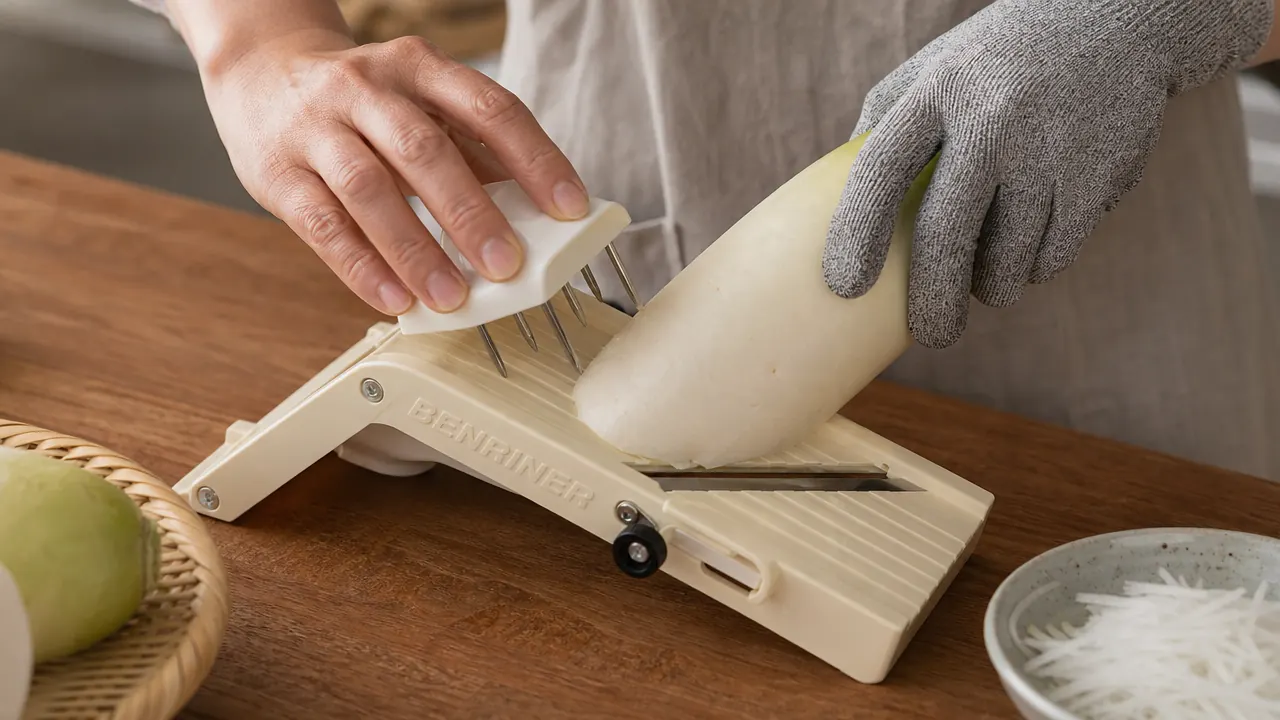
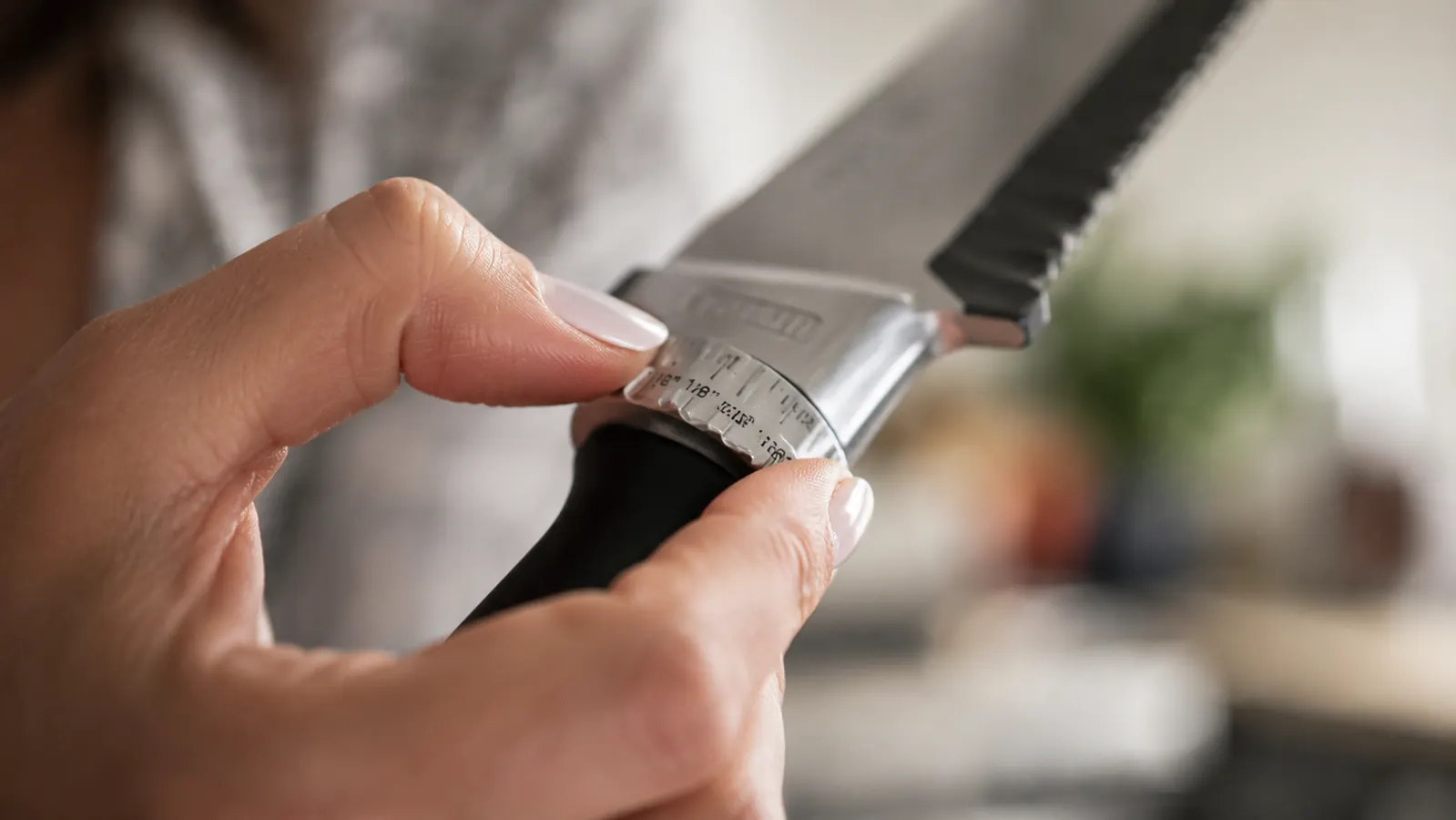
Here's the first thing that surprised me: almost nobody mentions that your first three or four slices on any new vegetable are basically throwaways. The thickness dial has fixed steps rather than a smooth continuous range, so dialing in the exact thickness you want for, say, a gratin takes a bit of trial and error every single time you switch vegetables, not just the first time you use the mandoline overall. I wasted half a zucchini my first week just testing settings before I got a batch I was happy with, and nothing I'd read beforehand warned me this recalibration happens with every new produce item, not once and done.
The ramp angle takes getting used to as well. The Benriner sits at a steeper pitch than the flat plastic V-slicers I'd used years earlier, which means the food travels toward the blade faster than you expect the first few times. My father, testing it for the first time, pushed too hard on his second pass and ended up with a slice twice as thick as the one before it, simply because he hadn't adjusted his pressure to the steeper angle yet.
It took me roughly two weeks of regular use before I stopped thinking about the mandoline every time I reached for it and started just using it the way I use a knife, without narrating every step in my head. Priyanka, testing it fresh, needed about twenty minutes just to get comfortable with the motion of loading food onto the guard's pins, which tells you the learning curve is real, but genuinely short if you're paying attention while you go through it.
None of this is a flaw exactly, it's just something nobody puts in the product description. Give yourself a genuine adjustment period, plan on a little wasted produce in week one, and don't judge the tool's precision by your first few passes on a new vegetable.
The Safety Habit That Actually Changed My Mind
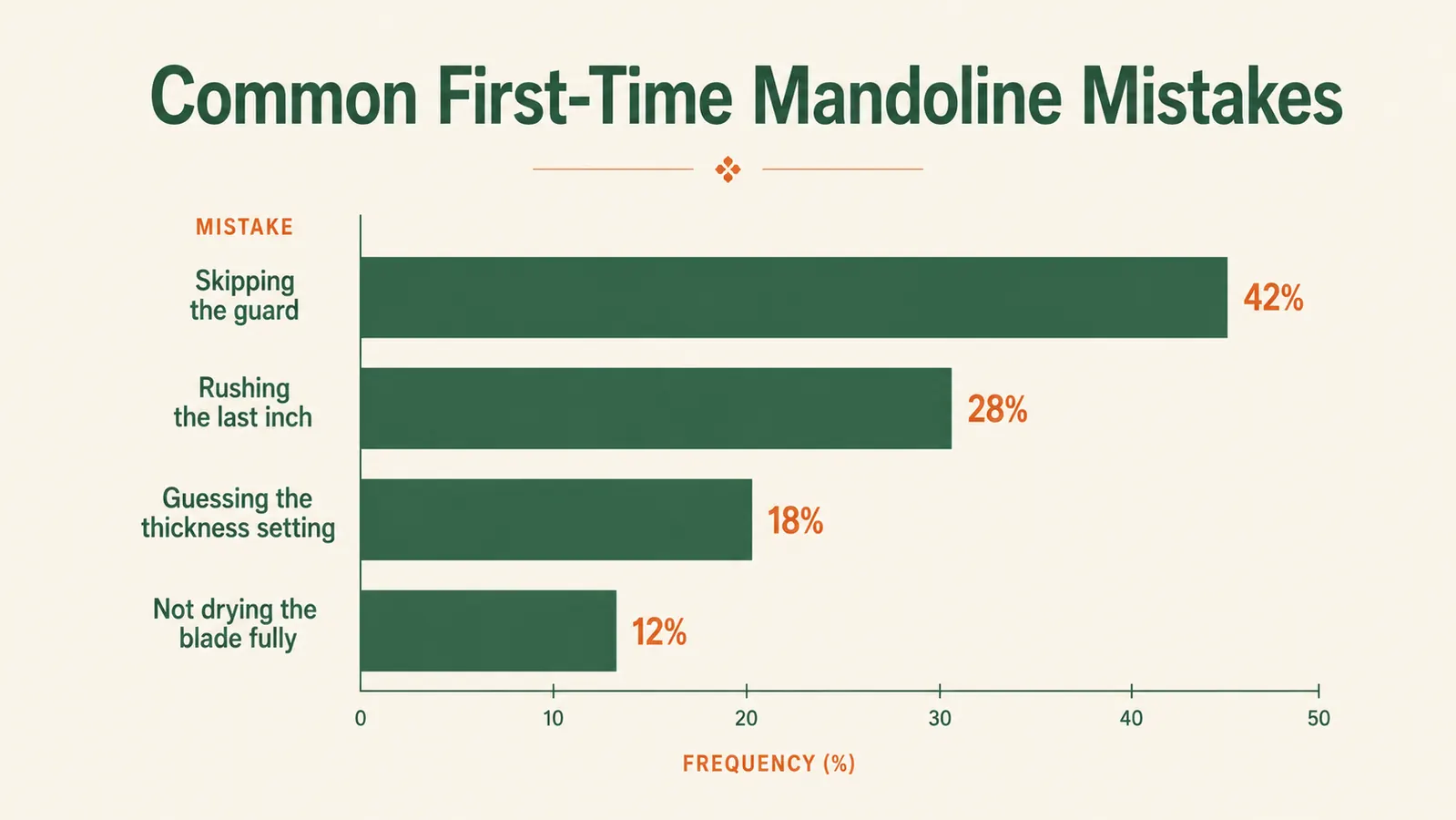
I'm not going to pretend this blade isn't serious. It is. But the internet's horror stories mostly come from people either skipping the guard entirely or using it on food it isn't built to hold securely, and almost none of the write-ups I read before buying explained what actually goes wrong in those moments. The guard's pins need enough surface area to bite into, which means very thin or oddly shaped pieces, the wide flat end of a sweet potato, for instance, don't seat as securely as a straight cucumber does.
The habit that actually changed things for me was pairing the guard with a thin cut-resistant glove on my non-dominant hand, the one that steadies the food before it goes onto the guard's pins. Nobody mentioned this combination to me before I bought it, and I only started doing it after my father nearly caught a knuckle on the mandoline's frame edge while reaching to reposition a piece of daikon that had shifted mid-slice.
That near miss wasn't the blade itself, it was the frame edge, which is something I hadn't even considered a risk before owning one. The blade gets talked about constantly online. The frame edges barely get mentioned at all, and in six weeks of testing, that's where the actual close call happened, not at the blade.
The guard also has real limits with soft produce. Its pins are built to grip firm vegetables, and when I tried it on a ripe tomato out of curiosity, more to see what would happen than because I actually needed tomato slices, the pins tore through the skin instead of holding it steady. That's not really a flaw so much as a boundary nobody spelled out clearly beforehand: this tool is built for firm, structured vegetables, and soft, delicate produce is where the guard's usefulness runs out fastest.
Is It Actually Too Sharp for Home Cooks?
This is the question in the headline, and I want to answer it directly instead of dancing around it. Yes, it is sharper than almost every knife in a typical home kitchen, sharper than it needs to be for most vegetables, and that sharpness is the entire point, it's what gives you clean, thin, consistent slices instead of ragged ones. Sharp isn't the same as dangerous, though. Dangerous is what happens when a very sharp blade meets an unprotected hand, and that's a habit problem, not a product problem.
Compared to the cheap plastic mandoline my cousin Elena used back in 2019, the blade here felt noticeably more predictable. It holds an edge and cuts with less pressure, which paradoxically makes it safer in practice, because you're not forcing food through with the kind of strain that makes a hand slip. The danger with a dull blade is that you push harder to compensate, and pushing harder is where accidents tend to happen in the first place.
So is it too sharp for home cooks? No, but it's sharp enough that it deserves the same respect you'd give a chef's knife you just had professionally sharpened, not the casual handling most of us give a butter knife. If that level of respect sounds like more mental overhead than you want from a kitchen tool, that's worth being honest with yourself about before you buy one.
Where the Design Falls Short
The plastic frame flexes more than I expected under real pressure. Pushing a dense sweet potato through on a thicker setting, I could feel a slight give in the ramp, nothing that felt unsafe, but enough that I noticed it and slowed down out of instinct. It's a small thing, but if you're coming from a metal food processor slicing disc, the difference in rigidity is noticeable the first time you feel it.
Cleaning is more of a production than I expected too. The set includes four interchangeable blade inserts, and swapping between them means handling and storing three sharp blades you're not currently using at any given moment. There's no case included for that, so I ended up buying a small zippered pouch separately just to keep the unused blades from rattling around loose in a drawer. That's an extra step and an extra purchase nobody mentioned in anything I read beforehand.
It's also hand-wash only, and the blade needs to be fully dried before it goes back into storage, since I noticed the faintest hint of water spotting on one insert after I let it air-dry standing in the rack instead of towel-drying it right away. Nothing has rusted or degraded, but it made me more diligent about drying everything immediately rather than letting it sit.
It's also louder than I expected against a hard cutting board, an audible scrape rather than a quiet glide, especially on firmer vegetables like sweet potato. And out of use, it doesn't collapse down as flat as I'd hoped, the ramp stays at a slight angle even folded, so it takes up a bit more vertical space in a drawer than a flat cutting board attachment would. Neither is a dealbreaker, but neither is mentioned anywhere in the product photos either.
What I Used Before, and Why I Switched
Before this, my slicing setup was a box grater for anything I needed shredded and a chef's knife for everything else, no mandoline at all. The box grater was fine for cheese and firm carrots, but it turned soft vegetables like zucchini into mush more often than clean slices, and it offered nothing for the paper-thin, uniform cuts a good gratin or quick pickle actually needs.
I also briefly owned a twelve dollar straight-edge mandoline years before this one, bought on a whim at a kitchen supply store, and it's worth mentioning why that one ended up in a donation pile within a month. Its thickness dial slipped under pressure mid-slice, so a single pass could start at one thickness and end at another, which defeated the entire purpose of owning a mandoline in the first place. The Benriner's dial has never slipped on me once, fixed steps and all.
I switched because I kept undercooking or overcooking parts of the same dish, thick potato slices staying firm while thin ones right next to them turned to mush in the oven. That inconsistency was the actual problem I was solving for, not speed. The Benriner solved it, but it introduced its own set of new habits I had to learn, which is really the honest tradeoff at the center of this whole review.
What I Liked
- Produces genuinely uniform slices once you're past the first few calibration passes
- Four interchangeable blades cover a wide range of cuts
- Steeper ramp moves food through quickly once you trust the angle
- Solves real cooking-consistency problems a knife or box grater can't
Where It Falls Short
- Fixed-step thickness dial means recalibrating with every new vegetable
- No storage case included for the three blades you're not using
- Frame flexes noticeably under pressure on dense, thick vegetables
- Guard doesn't seat securely on very thin or oddly shaped pieces
- Hand-wash only, with real risk of water spotting if not dried immediately
The blade gets all the warnings. In six weeks of testing, the actual close call happened at the frame edge, not the blade.
Who This Is For
If you're the kind of cook who's willing to treat the first few slices of any new vegetable as a calibration step rather than a wasted mistake, and you're comfortable adding a cut-resistant glove to your routine instead of relying on the guard alone, this earns a real place in a home kitchen. It's especially worth it if inconsistent slice thickness has actually caused you cooking problems before, uneven gratins, mushy pickles, that kind of thing.
It's also a good fit if you cook for more than just yourself on a semi-regular basis, since the setup and cleanup time only really pays off when you're slicing enough volume to justify it, a full dinner party's worth of vegetables rather than a single side dish for one. If most of your cooking is solo, small-batch meals, the return on that setup time is a lot less obvious, and that's worth weighing honestly before you buy.
Who Should Skip It
If you were hoping for a tool that requires zero adjustment period or extra habits beyond what's in the box, this isn't it. And if the idea of buying a separate pouch for blade storage or adding a glove to your routine sounds like more fuss than you want from a kitchen tool, a good knife and some practice might genuinely serve you better.
Still deciding if the learning curve is worth it?
See current pricing and availability for the Benriner Mandoline Slicer on Amazon.
Amazon Check Today's Price on Amazon →