
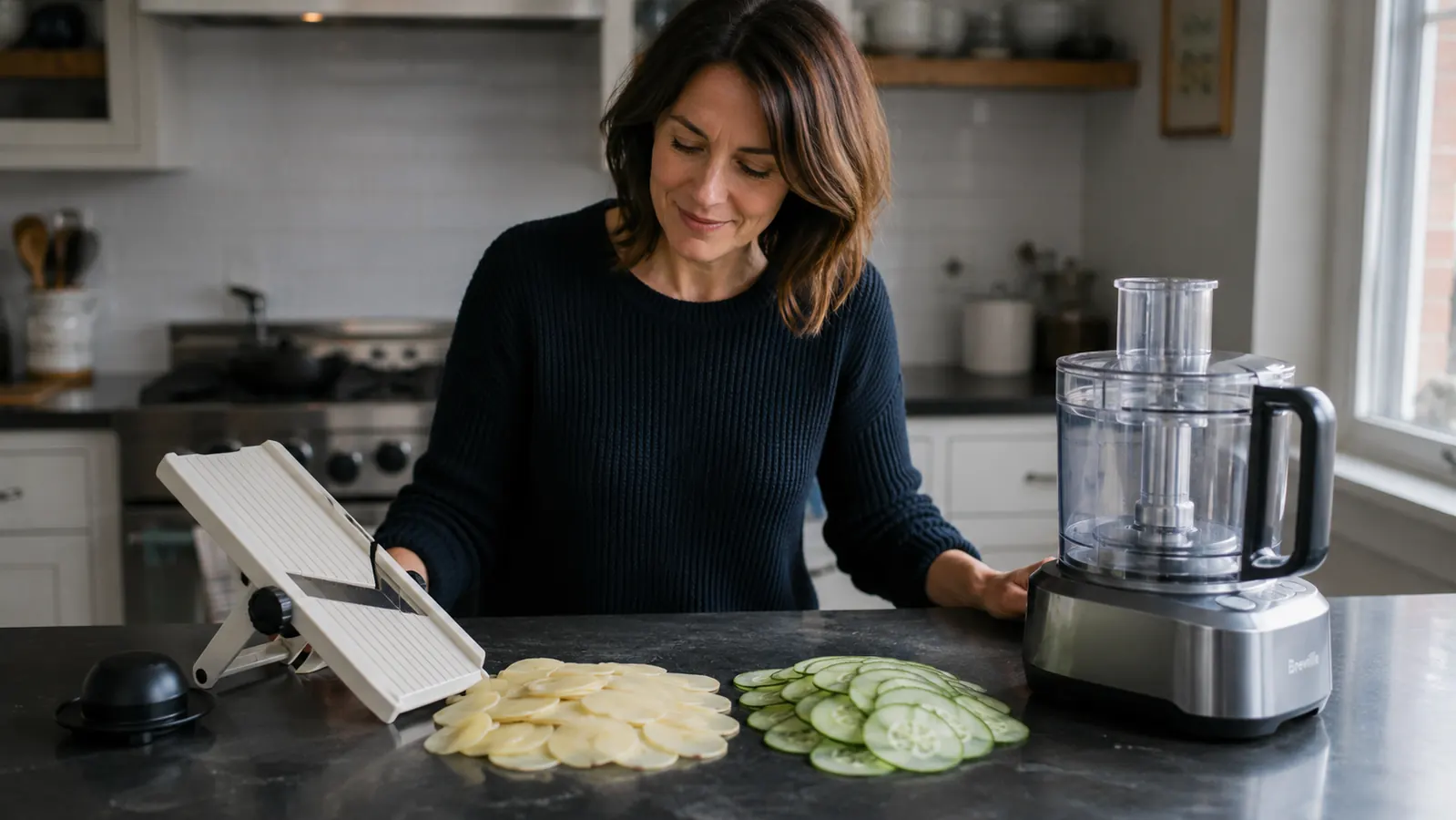
If you've ever stood at the counter wondering whether to pull out the food processor or just grab a mandoline for a pile of potatoes, cucumbers, or cabbage, here's the short answer from someone who owns both. My Benriner Japanese Mandoline Slicer slices thinner, more evenly, and more precisely than my food processor's slicing disc ever has, and it does it with almost no cleanup. The food processor still earns its spot in my kitchen, but not for slicing. It's the shredding disc and the pulse button that keep it out of storage, not thin, even slices.
I ran both tools through the same vegetables over two weeks of real dinners, not a lab test, just my actual weeknight cooking, to see which one I should reach for first when a recipe calls for thin, uniform slices. The mandoline won almost every category that mattered to me, thickness control, consistency, cleanup, and how the food actually looked on the plate. The food processor won on raw speed for big batches and on jobs where slicing wasn't really the point, like shredding a block of cheese or grating carrots for a slaw base.
How I Ran This Comparison
I kept this simple because I wanted an honest answer, not one that favored whichever tool I already liked better. Over two weeks I sliced potatoes for a gratin, cucumbers for a quick pickle, cabbage for slaw, and a couple of sweet potatoes for oven fries, running each vegetable through both the Benriner and my food processor's slicing disc. I alternated which tool went first each time so neither one got the freshest blade or the easiest batch of produce.
For the mandoline, I used the adjustable dial to match whatever thickness the recipe called for, usually somewhere between 1 and 3 millimeters depending on the vegetable. For the food processor, I used the slicing disc it came with, since that's the only slicing option most home food processors offer. I timed every pass from first cut to last, including the time it took to set up each tool and clean it afterward, because setup and cleanup are half of whether a gadget earns a place in my drawer.
I also graded the actual slices for evenness, since uneven slices cook unevenly, a real problem with something like scalloped potatoes where a few thick slices in the middle of the dish stay firm while the thin ones around them turn to mush. By the end of the two weeks I'd run each vegetable through both tools at least three times, enough to know each tool's real learning curve instead of judging it off a single clumsy first attempt.
| Benriner Mandoline | Food Processor | |
|---|---|---|
| Slice Thickness Range | 0.3mm to 6mm, dial-adjustable in fine steps | Fixed by whichever slicing disc is installed, usually 2-4mm |
| Slice Consistency | Every slice within a hair of the same thickness | Edges and center slices vary, especially on round vegetables |
| Time to Slice One Potato | About 22 seconds, including the dial adjustment | About 14 seconds once the machine is assembled |
| Setup and Assembly Time | Under 10 seconds, no assembly | 1 to 2 minutes to lock the bowl, lid, and disc in place |
| Cleanup | Rinse the blade and guard, dry in under a minute | Bowl, lid, disc, and pusher, several parts and a wash |
| Best For | Thin, uniform slices for gratins, chips, pickles | Shredding, grating, pureeing, big-batch volume |
| Storage Footprint | Lies flat, fits in a drawer | Bulky, needs a cabinet shelf or counter spot |
| Blade Safety | Exposed blade, needs the hand guard every time | Blade enclosed inside the bowl during use |
Where the Benriner Mandoline Wins
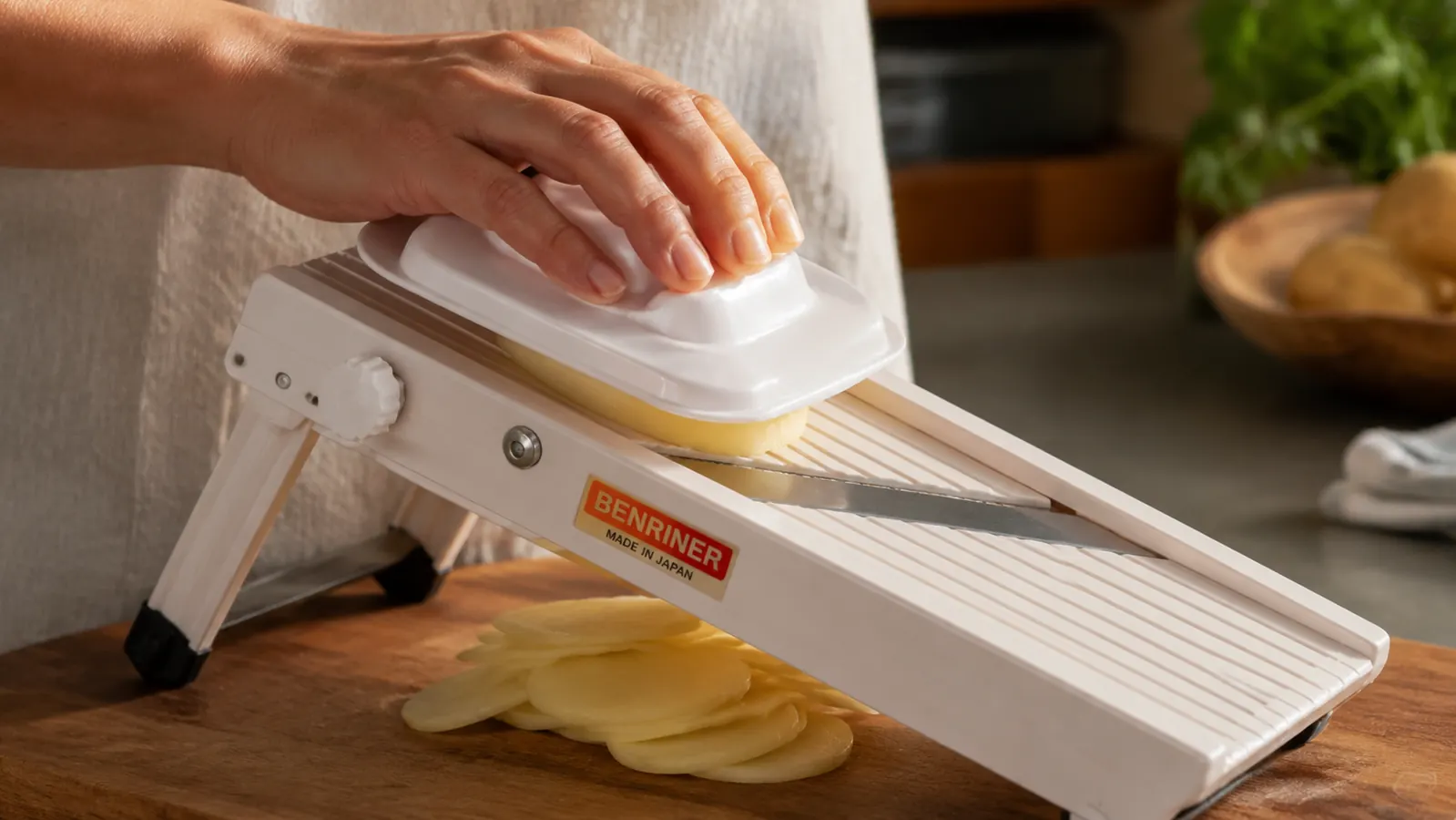
Thickness control is the whole reason I bought this thing, and it's still the reason I reach for it first anytime a recipe needs slices instead of chunks. The adjustable dial lets me dial in anything from paper-thin cucumber for a quick pickle to a solid 4 millimeters for potato gratin, and it holds that setting slice after slice without drifting the way a food processor's fixed disc does once the vegetable gets down to an awkward nub.
The other place it wins is consistency on round or irregular vegetables. My food processor's slicing disc handles a straight zucchini fine, but feed it a lumpy potato or a cabbage wedge and the slices come out uneven, thicker in spots where the vegetable didn't sit flush against the disc. The Benriner's flat sliding action doesn't care about the shape nearly as much, every pass through gives me a slice that's the same thickness as the last one, which matters more than I expected once I started noticing how much evenness affects cook time.
It's also just faster to get to the point of slicing. There's no bowl to lock in, no disc to seat correctly, no lid to click into place. I pull the Benriner out of the drawer, set the dial, and I'm slicing within ten seconds. For a quick side dish on a weeknight, that head start matters more to me than the food processor's slightly faster per-slice speed once it's actually running.
Tired of uneven potato slices ruining your gratin?
The Benriner Mandoline Slicer gives me the same paper-thin, dead-even slices every single time, no food processor disc-swapping required. Four stainless blades, one adjustable dial, ready to slice in ten seconds.
Amazon Check Today's Price on Amazon →A food processor chops food into pieces. A mandoline turns it into slices you'd actually plate.
Where the Food Processor Wins
I'm not going to pretend the food processor doesn't earn its keep, because it does, just not for slicing. When I need a whole block of cheese shredded for a big pan of enchiladas, or four carrots grated down for slaw in under a minute, nothing beats it. The bowl holds enough volume that I can process a full head of cabbage in one go, where the Benriner has me feeding it through in smaller batches by hand.
It also wins on safety for anyone nervous around an exposed blade. The Benriner's blade sits right at the surface of the slicing bed, and even with the hand guard I bought separately, I still slice with real attention every time I use it. My food processor's blade lives inside a locked bowl the entire time it's running, so if I've got my kids helping in the kitchen, that's the tool I hand them, not the mandoline.
And for pureeing, chopping nuts, or making a quick pesto, the food processor does things the mandoline simply can't do at all. If slicing were the only job in my kitchen I'd probably let the food processor go, but between the shredding disc, the blade attachment, and the sheer bowl capacity, it still has a job description the Benriner doesn't touch.
The Real Slicing Trial: Potato, Cucumber, Cabbage
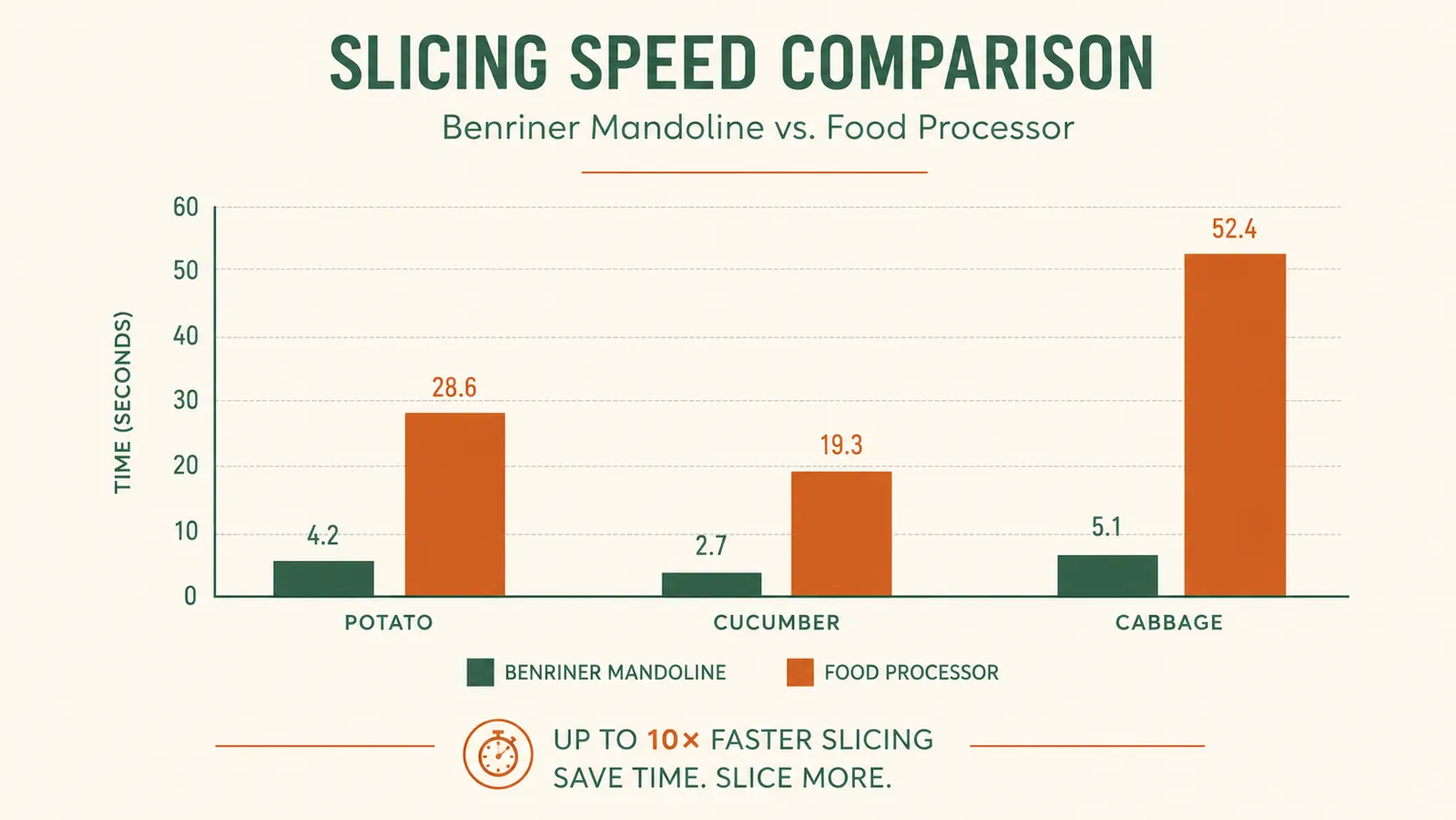
Here's what one actual side-by-side looked like. A medium russet potato through the Benriner at a 3mm setting took about 22 seconds and came out in slices so even I didn't have to sort through them before laying them in the gratin dish. The same potato through the food processor's slicing disc took about 14 seconds once the machine was already assembled, but a handful of end pieces came out noticeably thinner where the potato tipped in the feed tube.
Cucumbers were where the gap felt biggest. I wanted paper-thin rounds for a quick refrigerator pickle, thinner than my food processor's disc could go. The Benriner's finest setting got me there in about 30 seconds for one full cucumber. The food processor simply couldn't produce a slice that thin no matter how I angled the vegetable, so for that recipe it wasn't even a fair contest. Cabbage told a different story. Quartering a head and running it through the food processor took under a minute for the whole thing, while the same cabbage through the Benriner took closer to four minutes fed in smaller sections, a case where the processor's bowl capacity simply won on time.
Sweet potatoes for oven fries needed a slightly different setting, since I wanted matchstick-style planks rather than round slices. The Benriner handled this by pairing the mandoline with its included julienne insert, turning out fry-shaped strips in about 40 seconds per potato. My food processor doesn't come with a julienne attachment at all, so for that job there was no real comparison to run, the mandoline was simply the only tool of the two that could do it.
Cleanup and Storage
The Benriner rinses clean in under a minute, just the slicing bed and the blade guard, and it dries fast since there's so little surface area. The food processor is a bigger commitment every time, the bowl, the lid, the disc, and the pusher all need a wash, and I usually hand wash the disc separately since I don't love a sharp blade rattling around in the dishwasher rack with my other dishes. That adds real time on nights when I'm just trying to get a side dish onto the table.
Storage tips the scale even further toward the mandoline in my kitchen. The Benriner lies flat in a drawer, blades stored in their own sleeve, taking up less space than a large cutting board. My food processor lives on a shelf in a lower cabinet because the bowl and base together are too tall and bulky for a drawer, and I have to pull out two other things to get to it most of the time. In a small city kitchen where every inch of storage is already spoken for, that difference shows up more than the spec sheet suggests it should.
A Word on the Learning Curve
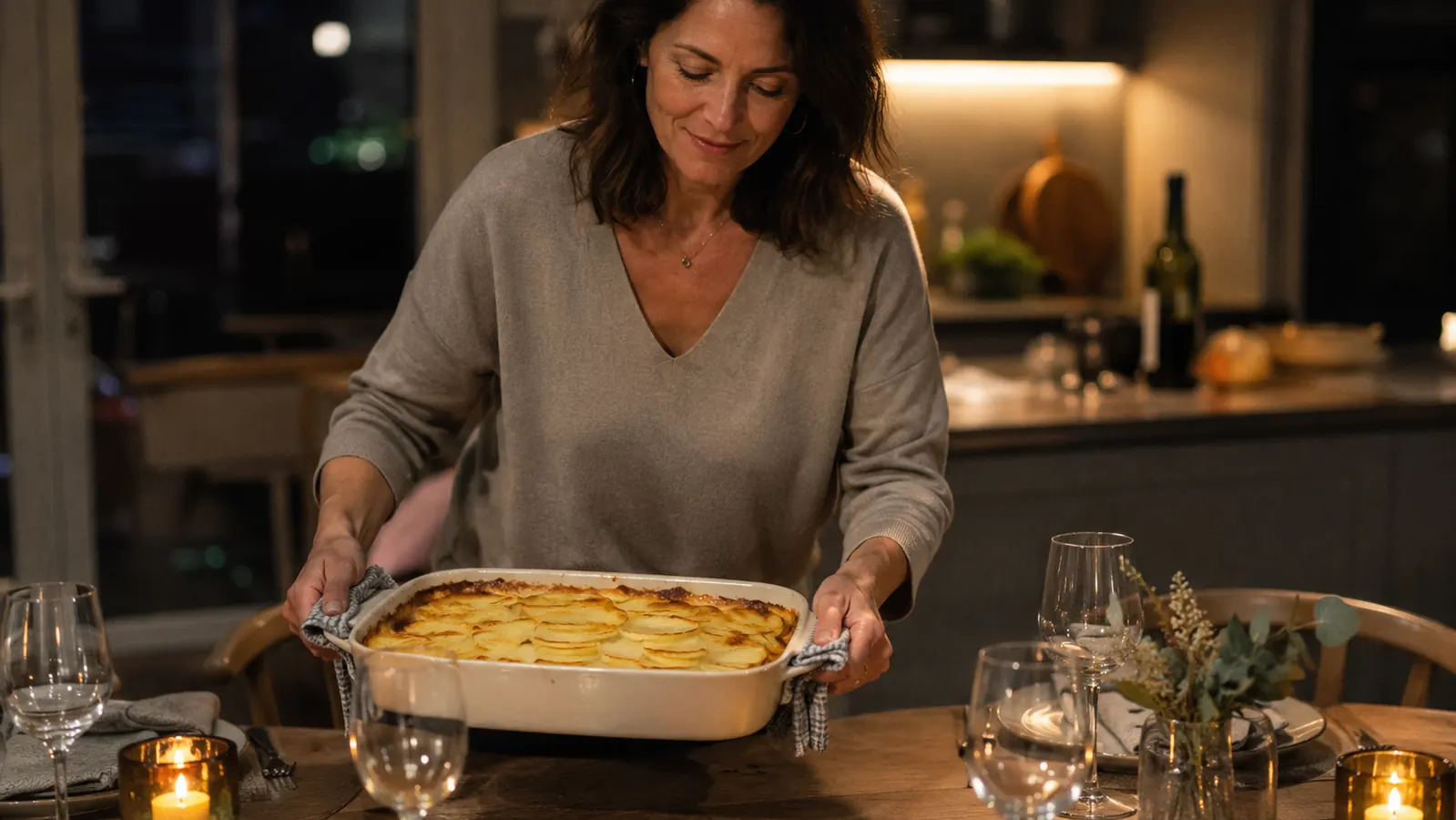
The Benriner isn't quite as instantly intuitive as pressing a button on a food processor. The first few times I used it, I sliced too fast and ended up with a couple of uneven pieces near the end of a potato, and I nicked the side of my thumb once before I started using the hand guard every single time, no exceptions. Give yourself two or three uses to get a feel for the right pressure and speed, after that it becomes as automatic as reaching for a knife.
Who Should Buy Which
If your cooking leans toward gratins, chips, quick pickles, salads, or anything where the thickness and evenness of the slice actually shows up on the plate, get the Benriner. It's a small, inexpensive tool that does one job better than a food processor's slicing disc ever will. If your kitchen work is more about shredding cheese, grating vegetables in bulk, or pureeing sauces and dips, keep the food processor doing what it's built for and let the mandoline handle the slicing. Most kitchens, mine included, end up needing both, just splitting the work between them instead of picking a favorite.
If you're deciding between buying one or the other for the first time, think about what frustrates you most right now. If it's slices that cook unevenly or vegetables that never come out looking like they do in the recipe photo, the mandoline solves that specific problem for very little money and very little counter space. If your bigger frustration is spending twenty minutes grating a mountain of cheese or shredding cabbage by hand, the food processor solves a different problem entirely, and no amount of mandoline practice will replace it.
Ready for slices that actually look like they came from a restaurant kitchen?
I reach for my Benriner Mandoline Slicer every time a recipe calls for thin, even cuts, my food processor still handles the shredding and pureeing. See today's price and blade options on Amazon before your next meal prep.
Amazon See Today's Price on Amazon →