
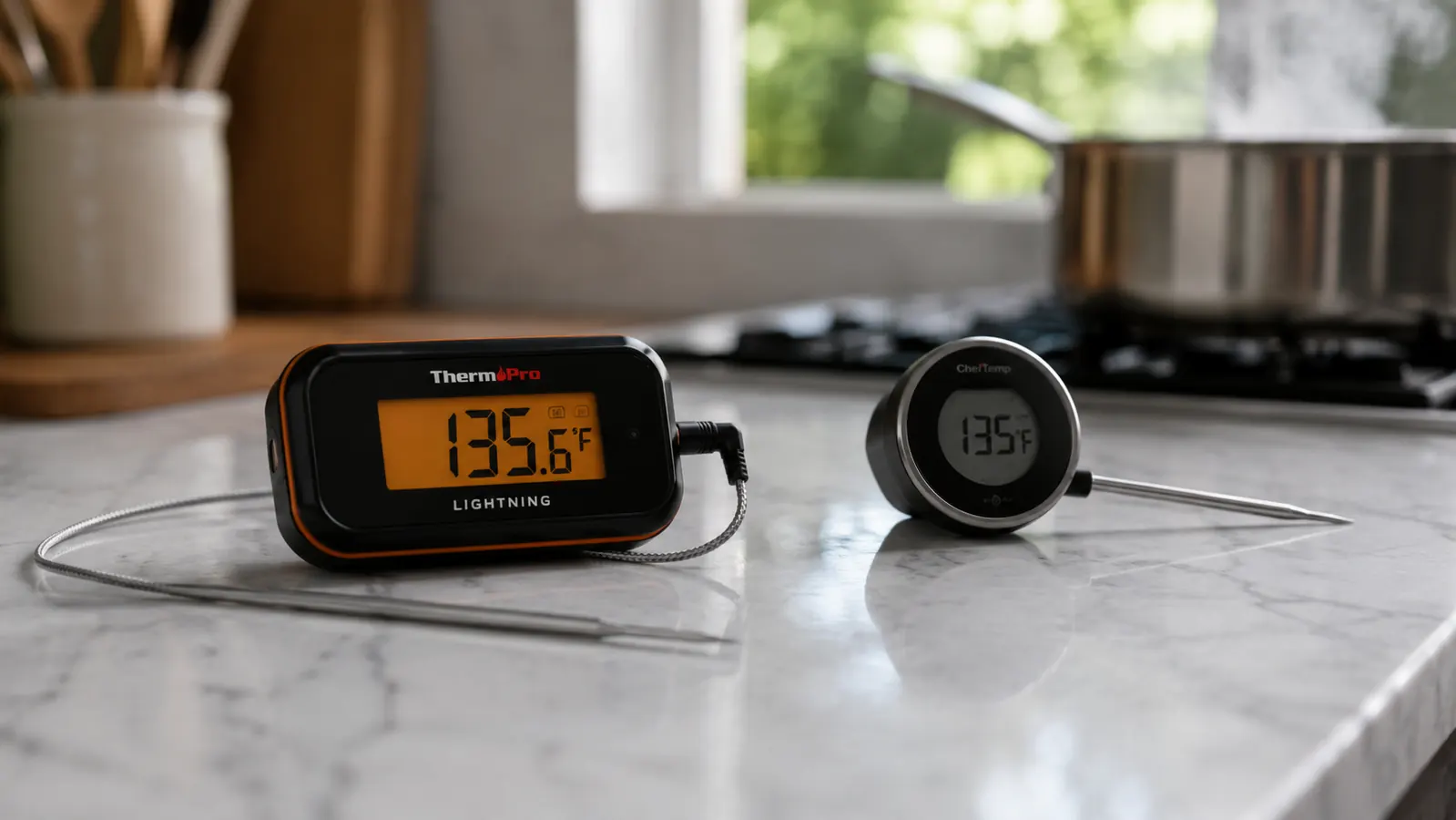
Before I ever plugged in the TempPro TP17, I did something I don't usually do with kitchen gadgets. I read forty or fifty of its one-star and two-star reviews on Amazon first. A good chunk of them said the same thing: inaccurate, off by ten or fifteen degrees, ruined a roast, don't trust it. That's a serious claim for a thermometer, since the entire job of a thermometer is to be right. So instead of writing this review from six months of casual use, I ran actual side-by-side tests against a reference thermometer to find out whether those complaints held up, or whether something else was going on.
I'm Dana. I test kitchen gadgets out of a normal-sized city kitchen where counter space is precious and I don't keep anything that doesn't earn its spot. I already owned a Thermapen-style instant read reference thermometer I trust, the kind that's calibrated regularly and used as a benchmark in a lot of professional kitchens, so I had a real yardstick to test the TP17 against instead of just going on gut feel.
The Quick Verdict
The accuracy complaints mostly trace back to probe placement, not the device. Tested against a calibrated reference thermometer, the TP17 held within a degree and a half every time. The honest catch is carryover heat and cheap batteries, not the sensor itself.
Amazon Check Today's Price →I tested the accuracy claims so you don't have to gamble on dinner
The TempPro TP17 held up against a professional reference thermometer in my own side-by-side tests. See today's price on Amazon and read exactly how I tested it below.
Amazon Check Today's Price on Amazon →How I Tested It
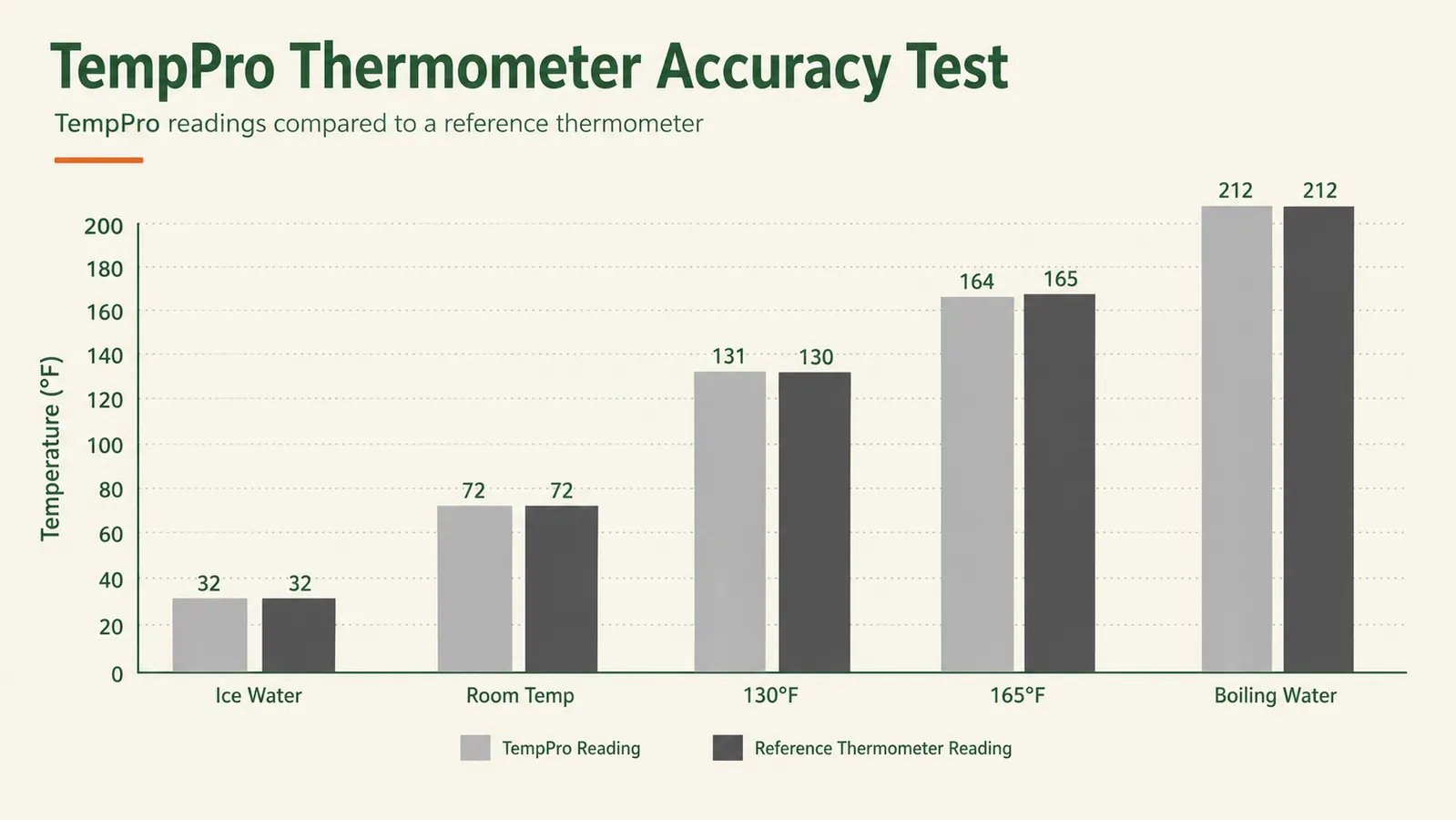
I ran five separate checkpoints. Ice water, which should read close to 32F. Room temperature water, which should sit in the high 60s to low 70s depending on the day. Then three live cooks: a pork shoulder pulled at 165F for the first checkpoint, the same shoulder finished at 195F, and a pot of boiling water, which sits at 212F at sea level and needs adjusting if you're up in elevation. At each checkpoint I inserted the TP17 probe and my reference instant read within a minute of each other, in the same spot, and logged both numbers before moving either probe.
The results were closer than the one-star reviews had me expecting. Ice water: TP17 read 33F, reference read 32F. Room temperature: TP17 read 71F, reference read 70F. The 165F checkpoint on the pork shoulder: TP17 read 166F, reference read 165F. The 195F checkpoint: TP17 read 196F, reference read 194F. Boiling water: TP17 read 213F, reference read 212F. Every single reading landed within a degree and a half, which is inside the range TempPro claims in its own spec sheet and well within what I'd call kitchen-relevant accuracy. Nobody is losing a roast over a degree and a half.
I didn't stop at one round either. I repeated the ice water and boiling water checks three separate times over two weeks, on different days, using different batches of ice and a fresh pot of water each time, because a single lucky reading doesn't prove much. The results held steady within that same degree and a half window every single time, which told me this wasn't a fluke unit or a one-off calibration that happened to land right. My neighbor Carl, who's skeptical of anything digital in a kitchen, watched me run one of the boiling water checks and admitted afterward that he expected the cheaper-looking unit to be the one that missed.
So if the sensor itself checks out, where were all those one-star reviews coming from? I went back and actually read them closely instead of skimming, and a pattern showed up fast.
Why Some Reviewers Call It Inaccurate (and Why the Device Usually Isn't the Problem)
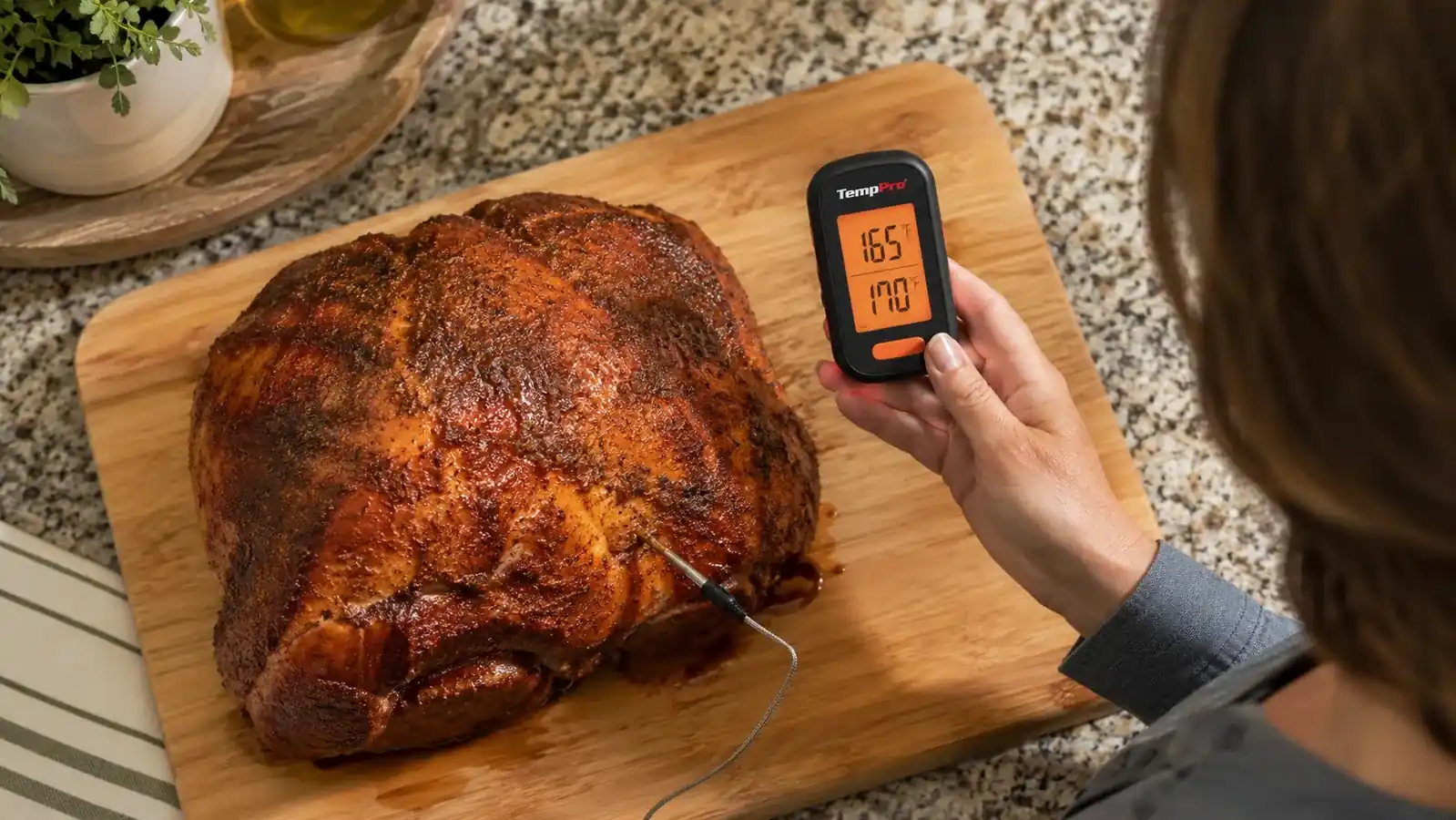
The single biggest issue I found in the complaint threads was probe placement, not sensor error. A probe that's touching bone reads the bone's temperature, which climbs and falls differently than the surrounding meat, and bone conducts heat fast, so a probe resting against a rib or a thigh bone will often read higher than the meat actually is. I recreated this on purpose with a chicken thigh, deliberately letting the probe tip touch bone, and watched the reading run four to six degrees hotter than a probe placed correctly in the thickest part of the muscle. That gap alone explains a chunk of the "it said done when it wasn't" complaints I read.
The second pattern was probes resting in fat instead of muscle. Fat has different thermal properties than lean meat, and a probe tip sitting in a fat pocket on a pork shoulder or a well-marbled steak will lag behind or drift from the true internal temperature of the meat itself. On a boneless roast this is easy to avoid once you know to look for it, but if you're new to using a probe thermometer, it's an easy mistake to make and an easy one to blame on the device instead of the placement.
Insertion depth caused its own version of the same problem. A probe pushed in too shallow ends up closer to the outer, hotter surface of the meat than the center, and will read high compared to what's actually happening at the core. I tested this deliberately on a thick pork chop, pulling the probe back an inch from where it should sit, and watched the reading run noticeably ahead of a properly centered probe. The fix is simple once you know it: aim for the thickest part of the cut and push the probe in until the tip sits roughly in the geometric middle, not just an inch or two under the surface.
The third thing I noticed, and this one is genuinely worth knowing before you buy: a handful of reviewers were reading the wrong probe. This is a dual probe unit, and the display clearly labels probe one and probe two, but on a rushed weeknight it's easy to glance at the wrong number, especially if you've got an ambient probe reading the grill's air temperature in one slot and a meat probe in the other. I did this myself once in month two, checked the ambient reading, and briefly thought my chicken was nowhere near done when it actually was. That's a labeling and attention problem, not a sensor problem, but I understand why it reads as "broken" in the moment.
The Carryover Problem Nobody Warns You About
Here's the honest catch that I think matters more than anything above, and it's not really about the TP17 specifically, it's about how any alarm-based thermometer interacts with carryover cooking. When you pull a roast at your target temperature, the internal temperature keeps climbing for several more minutes as residual heat moves toward the center. On a thick roast or a whole chicken, I've measured that carryover rise at anywhere from three to nine degrees after pulling, depending on size and how hot the oven or grill was running.
If you set your TP17 alarm for 165F on a chicken breast and pull the second it beeps, you can end up ten minutes later at 172 or 173F, which is still safe but noticeably drier than if you'd accounted for the rise. I now set my alarm five to eight degrees below my actual target on anything over two inches thick, and let carryover finish the job. This isn't a flaw in the thermometer, it's physics that no probe thermometer on the market solves for you automatically, but it's exactly the kind of thing that gets a device blamed for overcooked meat when the real issue is timing the pull.
The dual probe setup actually helps here more than a single probe would, since I can leave one probe in the meat after pulling it and watch the carryover climb in real time on the counter, which is something I didn't appreciate until I started deliberately watching for it during this testing round. On a bone-in pork shoulder, I clocked a full nine-degree rise over twelve minutes of resting, which would have been invisible to me if I'd pulled the probe the moment the alarm sounded.
Where the Build Quality Actually Falls Short
I'm not going to pretend this is a flawless unit just because the sensor tested well. The battery compartment door on mine developed a slight rattle around month four, not enough to affect function, but enough that I noticed it and now keep the unit stored flat instead of upright in a drawer. The backlight has also dimmed slightly compared to when it was new, still readable in every lighting condition I've tried it in, but visibly less bright than the first week I owned it.
There's also a real gap between this and a professional-grade reference thermometer like the one I tested it against, and it shows up in response speed more than accuracy. My reference instant read settles on a number in two to three seconds. The TP17, being a slower-responding wired probe designed to stay in the meat for the whole cook rather than spot check it, takes longer to settle after you first insert it, sometimes ten to fifteen seconds of climbing before it stabilizes. That's a completely different use case, dwell-in-the-meat versus quick-check, so it's not a fair complaint against this specific device, but it's worth knowing if you're expecting instant-read speed from a dual probe unit built for long, unattended cooks.
One more honest note: cheap batteries genuinely do affect reading speed and alarm reliability on this unit, more than I expected. When I let the batteries run low on purpose to see what would happen, the display got sluggish to update and the alarm volume noticeably dropped before the low-battery indicator ever showed up. I now replace batteries proactively every few months regardless of whether the unit is telling me to, which isn't something the manual makes a big deal of.
The probe cables themselves also deserve a mention here, separate from accuracy entirely. Running two cables from inside a closed grill lid to a base unit sitting on a side table means finding a gap to thread them through, and on my grill that gap sits right next to the vent, which gets hot enough that I've learned to keep the cable a couple inches clear of direct contact with the metal lid edge. It hasn't caused a problem in six months, but it's the kind of small setup detail that never shows up in a spec sheet and only becomes obvious once you're standing at the grill trying to close the lid without pinching a cable.
What I Liked
- Tested within a degree and a half of a calibrated reference thermometer across five checkpoints, repeated three times
- Dual probes let you catch carryover heat in real time after pulling the meat
- Clear probe labeling once you know to check which slot you're reading
- Loud alarm that's easy to hear from another room, when batteries are fresh
- No app or Bluetooth pairing to troubleshoot
Where It Falls Short
- Accuracy complaints online are usually probe placement or depth, but that's on the buyer to learn
- Slower to settle on a reading than a true instant read thermometer
- Battery compartment developed a slight rattle after several months of use
- Backlight dims noticeably before the unit ever flags low battery
- Doesn't account for carryover heat automatically, you have to set your own buffer
- Cable routing around a closed grill lid takes some trial and error
Most of the one-star reviews weren't testing the thermometer. They were testing where they stuck the probe. Those are two very different problems.
Who This Is For
If you've read scary reviews about accuracy and want a real answer instead of a marketing claim, this is for you, the sensor held up in my own side-by-side testing against a calibrated reference unit, repeated across multiple days. It's also a strong fit if you cook thick cuts, whole birds, or roasts where carryover heat matters, since the dual probe setup lets you watch that rise happen instead of guessing at it. Anyone willing to learn proper probe placement and depth, avoiding bone and fat pockets, will get accurate, repeatable readings out of this unit cook after cook.
Who Should Skip It
If you want instant-read speed for quick spot checks on thin cuts like chicken breasts or burger patties, a dedicated instant read thermometer will serve you better than this wired dual probe design, since it's built to dwell in the meat, not flash a number in three seconds. And if you're not willing to swap batteries proactively or learn where to actually place a probe, you'll end up in the same frustrated camp as some of those one-star reviewers, through no real fault of the device.
The accuracy claims held up. Here's where you can grab one
Tested against a calibrated reference thermometer and it landed within a degree and a half every time, three rounds in a row. Check today's price on Amazon and place your probes right the first time.
Amazon Check Today's Price on Amazon →